Vintage Mid Century Credenza vs Reproduction: A Living Room Storage Buying Filter
Design theme: Mid-century modern
A practical decision filter for the vintage mid century credenza vs reproduction question — what to check on doors, drawers, and wood before you buy, plus a worked example.
As an Amazon Associate, Nido earns from qualifying purchases.
A credenza is one of the few pieces in a first apartment that has to do three jobs at once: hide the router and extra linens, anchor the room visually, and survive a move without falling apart. That's exactly why the vintage mid century credenza vs reproduction decision deserves more scrutiny than picking a side table or a lamp. Doors and drawer fronts hide a lot of construction detail that a quick photo can't show you, and a credenza that looks identical to a costly original in a listing photo can be built on particle board underneath. This guide walks through what to actually check, in what order, before you commit a chunk of your living room budget to one piece.
Note: this is a general buying framework, not an appraisal service. For anything you're paying real money for, the checks below are a starting point, not a substitute for examining the piece in person.
Why credenzas are harder to judge than chairs or tables
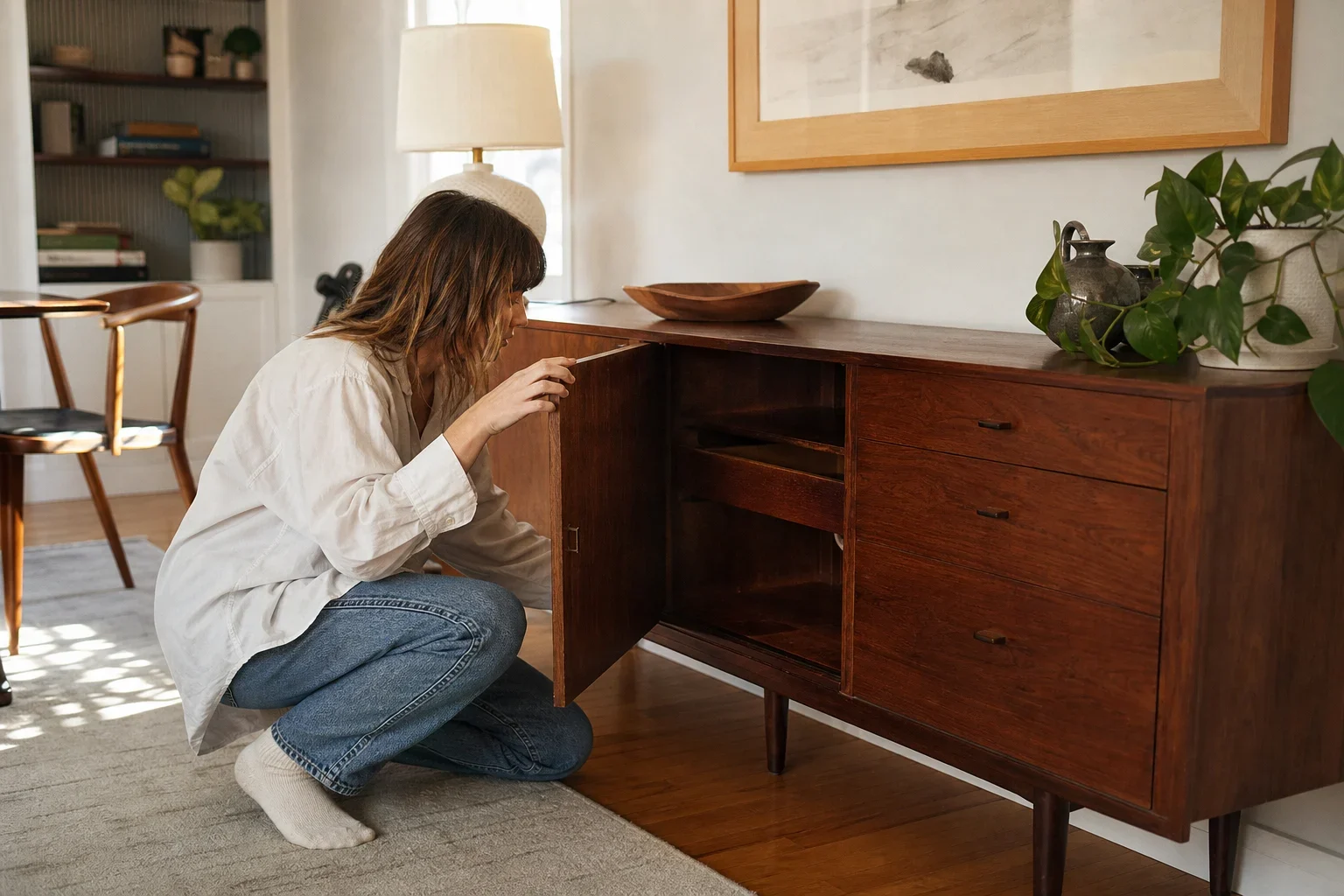
A dining chair shows you its joinery from every angle. A credenza hides most of its structure behind doors and drawer fronts, and the parts you can see — the top, the exterior sides, the pulls — are the easiest parts for a reproduction to get right. The parts that actually tell you what you're buying are inside: the drawer boxes, the back panel, and the underside. If a seller's listing only shows the closed front, that's a reason to ask for more photos before you drive across town, not a reason to skip the check.
Vintage mid century credenza vs reproduction: the construction test
Construction is the most reliable signal you have, because it's expensive and slow for a reproduction to fake convincingly. Open every drawer and look at the piece from underneath and behind before you look at anything cosmetic.
- Pull a drawer all the way out. Quality vintage case pieces typically used solid secondary wood — pine, poplar, or birch — for drawer boxes and interior frames, not plywood, MDF, or particle board. Any particle board in a structural role on a piece claimed to be from the 1950s to 1970s is a strong indicator of reproduction or later production.
- Check the joints. Look for interlocking joinery at the drawer corners rather than a stapled or nailed butt joint — stapled drawer boxes are a modern shortcut and a common reproduction tell.
- Lift one end. Vintage furniture is consistently heavier than modern reproductions, because real solid wood or quality plywood is denser than the engineered wood used in most budget rebuilds. If a credenza feels surprisingly light for its size, treat that as a flag worth investigating further, not a dealbreaker on its own.
- Look at the screws. Phillips head screws became widespread in US and UK manufacturing during the 1940s and 1950s, while slotted screws remained common in European production later — if the hardware doesn't match the claimed origin and era, ask the seller about it.
- Check the wood species against the era. Solid teak, walnut, oak, and rosewood were commonly used in genuine mid-century case goods, often with quality veneer over a solid core. A credenza claimed as solid teak that feels suspiciously light, or has a grain pattern that repeats too perfectly, is worth a second look.
Maker's marks and labels: useful, but not proof on their own
Many mid-century manufacturers marked their work — a metal tag or paper label on the back of a case piece or inside a drawer is common for makers like Lane, and Danish pieces often carry a Made in Denmark stamp, burned in or ink-stamped on the back or underside. A mark is a helpful data point, but labels can be reproduced too, so treat a maker's mark as one signal among several rather than the deciding factor. If a listing leans entirely on a name with no construction detail to back it up, that's a reason to ask more questions.
Mid-century modern product idea: Lightdot 64IN Dimmable Globe Floor Lamp, Gold Standing Lamps with 4PCS 3000K Bulbs Warm White, Mid Century Modern Floor Lamp with 5Lbs Heavy Base for Living Room/Bedroom/Sofa Beside/Corner Decor. Once you've settled the credenza itself, a floor lamp like this one helps anchor the rest of the seating area around it without competing for attention. Placed beside a sofa or in a corner near the credenza, a globe-style lamp with a weighted base adds height and warm light to balance a low, horizontal case piece, which is a common pairing in mid-century-inspired living rooms. The dimmable warm-white bulbs also let you adjust ambiance for evening use, which is worth factoring in as you finalize the room's lighting plan alongside your storage piece.
Patina and wear: does the story match the object?
Authentic vintage pieces show wear that follows logic — feet, handles, and drawer runners that get touched or dragged show more wear than a protected back panel or an interior shelf. If wear is spread evenly and randomly across the whole piece, or the finish looks uniformly aged in a way that doesn't match how a credenza actually gets used, it may have been artificially distressed to look older than it is.
Where reproduction and budget-inspired pieces genuinely make sense
None of this is an argument against reproduction or budget-inspired credenzas — it's an argument for knowing which one you're buying. A licensed reissue or an honestly labeled budget piece with a solid plywood carcass can be the right call for a first apartment, especially if the room's real constraint is a specific width for a specific wall. The problem isn't reproduction furniture; it's paying vintage prices for a piece that was never vintage to begin with. Vintage furniture in the general market typically means a piece that's roughly 20 to 99 years old and was made in the period it represents — reproduction furniture is made later to replicate that look, and both can be a fair deal if the price reflects what you're actually getting.
Worked example: fitting a found credenza to your room and budget
This is a hypothetical walkthrough to show how the checks above turn into a decision — not a real listing or price.
The scenario: a reader furnishing a living room finds a listing for a vintage teak credenza with no interior shots, only a photo of the closed front.
Mid-century modern product idea: SAFAVIEH Rodeo Drive Area Rug 6'x9', Mid-century Modern Gold RD863A. A living room built around a mid-century credenza usually needs a rug that grounds the seating area without clashing with the case piece's lines, and a rug in this size range is a reasonable starting point for anchoring a sofa and coffee table setup in front of it. Choosing a patterned or gold-toned rug described as mid-century in style gives you a coordinated palette to work from when you're placing the credenza against a wall and building the rest of the room around it. As with the credenza itself, checking the rug's actual dimensions against your floor plan before buying avoids a mismatch once everything is in the room.
- Message the seller for interior and underside photos before arranging a viewing — asking to see the drawer boxes and back panel costs nothing and rules out obvious reproductions early.
- Measure the wall first. Nido's room-by-room planning lays out what a living room needs and where, so the reader checks the credenza's listed dimensions against the actual wall and TV placement before falling in love with it.
- At the viewing, run the construction test — pull a drawer, check the secondary wood, lift a corner, check the screws.
- If it checks out — solid secondary wood, weight matches solid construction, wear in the right places — the asking price is reasonable for a genuine vintage teak piece and it's added to the room's storage line item.
- If it doesn't — particle board drawer boxes, stapled joints, suspiciously light — the reader treats it as a nicely styled reproduction and uses that same price as a ceiling, not a floor, when comparing it against other options Nido's AI picks surface for the same spot and budget.
Either outcome, the decision gets made before money changes hands, and the room's budget stays intact either way.
An 8-point checklist before you buy a credenza
- Ask for interior and underside photos if they're missing from the listing
- Pull every drawer and check the secondary wood for particle board or MDF
- Check drawer joints for interlocking joinery versus staples
- Lift a corner and gauge the weight against the claimed materials
- Check screw types against the claimed era and origin
- Look for a maker's mark or label, and note it without treating it as final proof
- Check that wear patterns match how the piece would actually be touched and used
- Measure the piece against your actual wall and remaining room budget before you commit
Frequently asked questions
What's the single fastest way to spot a reproduction credenza?
Pull out a drawer and look at the sides and bottom. Solid secondary wood like pine, poplar, or birch points to genuine vintage case-goods construction, while plywood, MDF, or particle board in that structural role is a strong sign of a reproduction, especially on a piece claimed to be from the 1950s to 1970s.
Does a maker's label guarantee a credenza is authentic vintage?
No. A label or stamp — like a metal tag from Lane or a Made in Denmark stamp — is a useful clue, but labels can be reproduced or misapplied. Treat a mark as one piece of evidence alongside construction, weight, and wear, not as proof on its own.
Is a lightweight credenza always a red flag?
It's a flag worth investigating, not an automatic disqualifier. Vintage furniture is generally heavier than modern reproductions because solid wood and quality plywood are denser than the engineered wood used in many budget rebuilds, so a surprisingly light piece deserves a closer look at the materials before you buy.
Mid-century modern product idea: 22‘’x48'' Asymmetrical Mirror with Wood Frame, Small Irregular Wall Odd Shaped Mid Century Modern Mirror Christmas Decor for Bedroom Living Room Entryway Hall (Wood). An asymmetrical wood-framed mirror can work well hung above or near a credenza, adding visual interest to the wall without requiring another large piece of furniture, and its irregular shape offers a counterpoint to the credenza's straight lines and horizontal mass. Since credenzas are often placed against a feature wall, a mirror in this spot can also help bounce light around a room that's otherwise anchored by heavier wood tones. Confirm the mirror's actual size fits the wall space you have left after the credenza is placed, the same way you'd check any other piece against your room measurements.
How old does a credenza need to be to count as vintage rather than reproduction?
In general usage, vintage furniture refers to pieces roughly 20 to 99 years old that were made during the era they represent, while reproduction furniture is made later to replicate that look. A piece can be well made and still not be vintage — the age and the construction era are what separate the two categories, not just the style.
Is it ever fine to buy a reproduction credenza on purpose?
Yes. A clearly labeled reproduction or licensed reissue can be the right call when you need a specific size for a specific wall, or when your budget doesn't stretch to vintage prices. The goal of this filter isn't to rule out reproductions — it's to make sure the price you're paying matches what the piece actually is.
How does this fit into planning the rest of the living room?
A credenza is usually one of the larger line items in a living room plan, so it helps to know your wall dimensions and remaining budget before you shop. Laying out the room's full item list first makes it easier to see how much room a credenza purchase leaves for the rest of the space.
Shop the Mid-century modern look
As an Amazon Associate, Nido earns from qualifying purchases.

Lightdot 64IN Dimmable Globe Floor Lamp, Gold Standing Lamps with 4PCS 3000K Bulbs Warm White, Mid Century Modern Floor Lamp with 5Lbs Heavy Base for Living Room/Bedroom/Sofa Beside/Corner Decor
Once you've settled the credenza itself, a floor lamp like this one helps anchor the rest of the seating area around it without competing for attention. Placed beside a sofa or in a corner near the credenza, a globe-style lamp with a weighted base adds height and warm light to balance a low, horizontal case piece, which is a common pairing in mid-century-inspired living rooms. The dimmable warm-white bulbs also let you adjust ambiance for evening use, which is worth factoring in as you finalize the room's lighting plan alongside your storage piece.
View on Amazon
SAFAVIEH Rodeo Drive Area Rug 6'x9', Mid-century Modern Gold RD863A
A living room built around a mid-century credenza usually needs a rug that grounds the seating area without clashing with the case piece's lines, and a rug in this size range is a reasonable starting point for anchoring a sofa and coffee table setup in front of it. Choosing a patterned or gold-toned rug described as mid-century in style gives you a coordinated palette to work from when you're placing the credenza against a wall and building the rest of the room around it. As with the credenza itself, checking the rug's actual dimensions against your floor plan before buying avoids a mismatch once everything is in the room.
View on Amazon
22‘’x48'' Asymmetrical Mirror with Wood Frame, Small Irregular Wall Odd Shaped Mid Century Modern Mirror Christmas Decor for Bedroom Living Room Entryway Hall (Wood)
An asymmetrical wood-framed mirror can work well hung above or near a credenza, adding visual interest to the wall without requiring another large piece of furniture, and its irregular shape offers a counterpoint to the credenza's straight lines and horizontal mass. Since credenzas are often placed against a feature wall, a mirror in this spot can also help bounce light around a room that's otherwise anchored by heavier wood tones. Confirm the mirror's actual size fits the wall space you have left after the credenza is placed, the same way you'd check any other piece against your room measurements.
View on Amazon