The Home Office Corner: A Mid-Century Modern Desk and Office Chair Buying Filter
Design theme: Mid-century modern
Furnishing a work-from-home corner? Use this checklist to decide between a vintage mid-century modern desk and office chair, a licensed reissue, or a budget-inspired pair that still works for your body.
As an Amazon Associate, Nido earns from qualifying purchases.
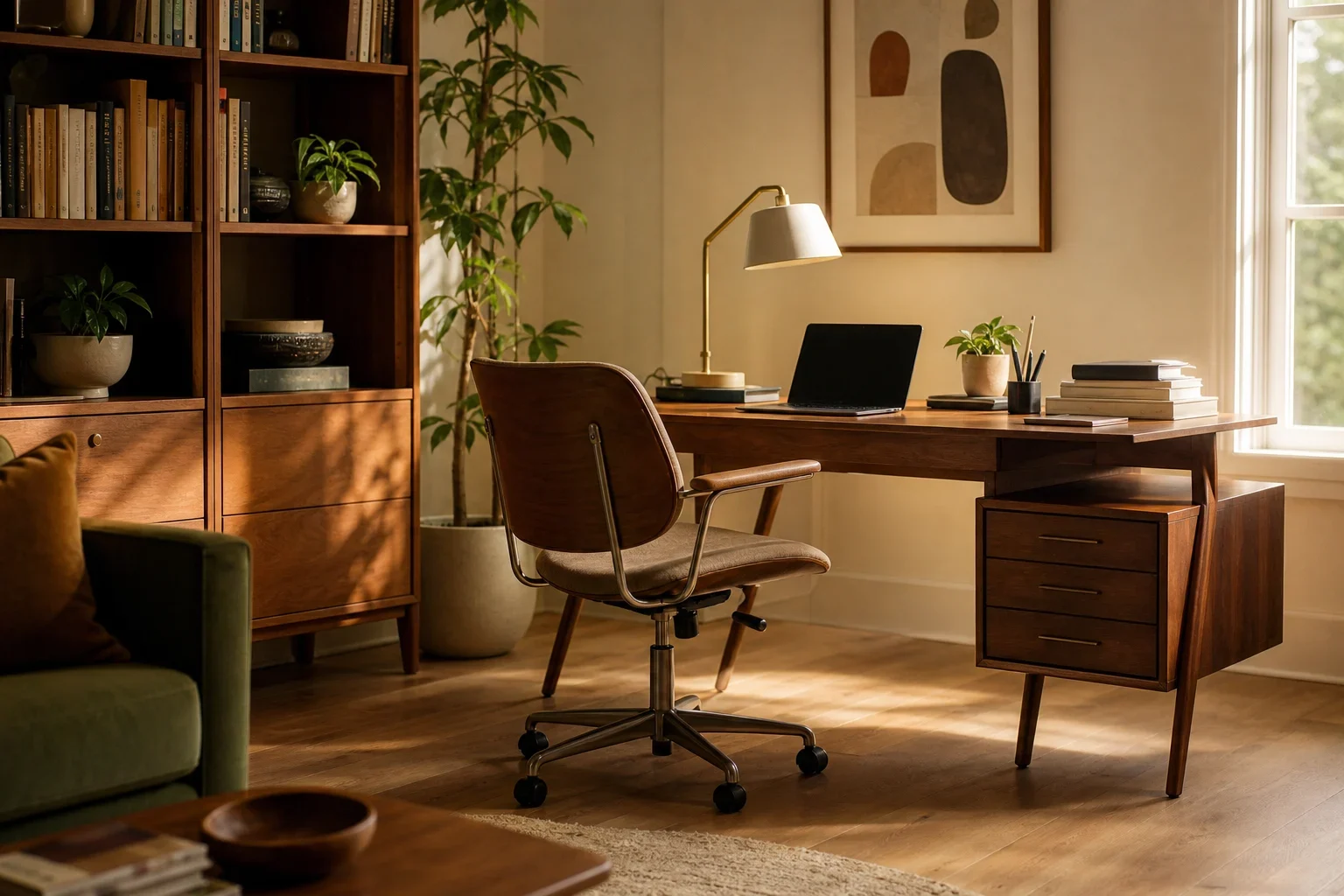
A work-from-home corner asks more of its furniture than a living room console does. You don't just look at a mid-century modern desk and office chair — you sit in it for hours, lean your weight on it, and expect it to hold up under daily typing and video calls. That makes the vintage-versus-reproduction decision a little different here than it is for a coffee table or sideboard: authenticity still matters if you care about it, but ergonomics and daily durability can outrank patina.
This guide gives you a narrow, practical filter for exactly two pieces — the desk and the task chair — so you can furnish a home office corner without overpaying for history you don't need, or underpaying for support your back will miss in month three.
Mid-century modern desk and office chair: vintage vs. reproduction, decided separately
Most identification guides treat mid-century modern as one bucket: check the joinery, check the wood, check the maker's mark, done. That approach works reasonably well for a credenza or a coffee table, which mostly need to look right and hold weight evenly. A desk and especially a task chair have an extra requirement layered on top: they need to fit how you actually sit and work, which a 1962 secretarial chair was not necessarily designed to do for a modern laptop setup.
So the filter below splits into two tracks — one for the desk, which is closer to traditional case-goods authentication, and one for the chair, where function should usually outweigh provenance unless you're a genuine collector.
Desk track: run the standard authentication checks, then ask if it still works as a desk
A mid-century modern desk is still a piece of case furniture, so the same construction signals that apply to sideboards and dressers apply here. Industry guides on authenticating vintage furniture point to a consistent set of checks: open a drawer and look at the joinery — hand-cut dovetails with slightly irregular spacing are a sign of genuine period construction, while stapled or nailed drawer boxes are a common reproduction shortcut. Flip the piece over or pull a drawer fully out to look at the secondary wood; quality vintage pieces used solid pine, poplar, or birch for drawer sides and backs rather than particle board or MDF, which wasn't used structurally in quality furniture before the 1980s.
Mid-century modern product idea: Dawnwake Mushroom Lamp Table Lamp for Bedroom-Small Desk Table Lamps,Orange. A compact table lamp like this is a reasonable finishing touch for the work corner once you've settled the desk-versus-chair decision: its small footprint keeps it from competing with a writing surface you've already measured for monitor and keyboard clearance, and a warm accent light is the kind of low-stakes, budget-inspired addition the article recommends reserving for pieces that don't need an authenticity check.
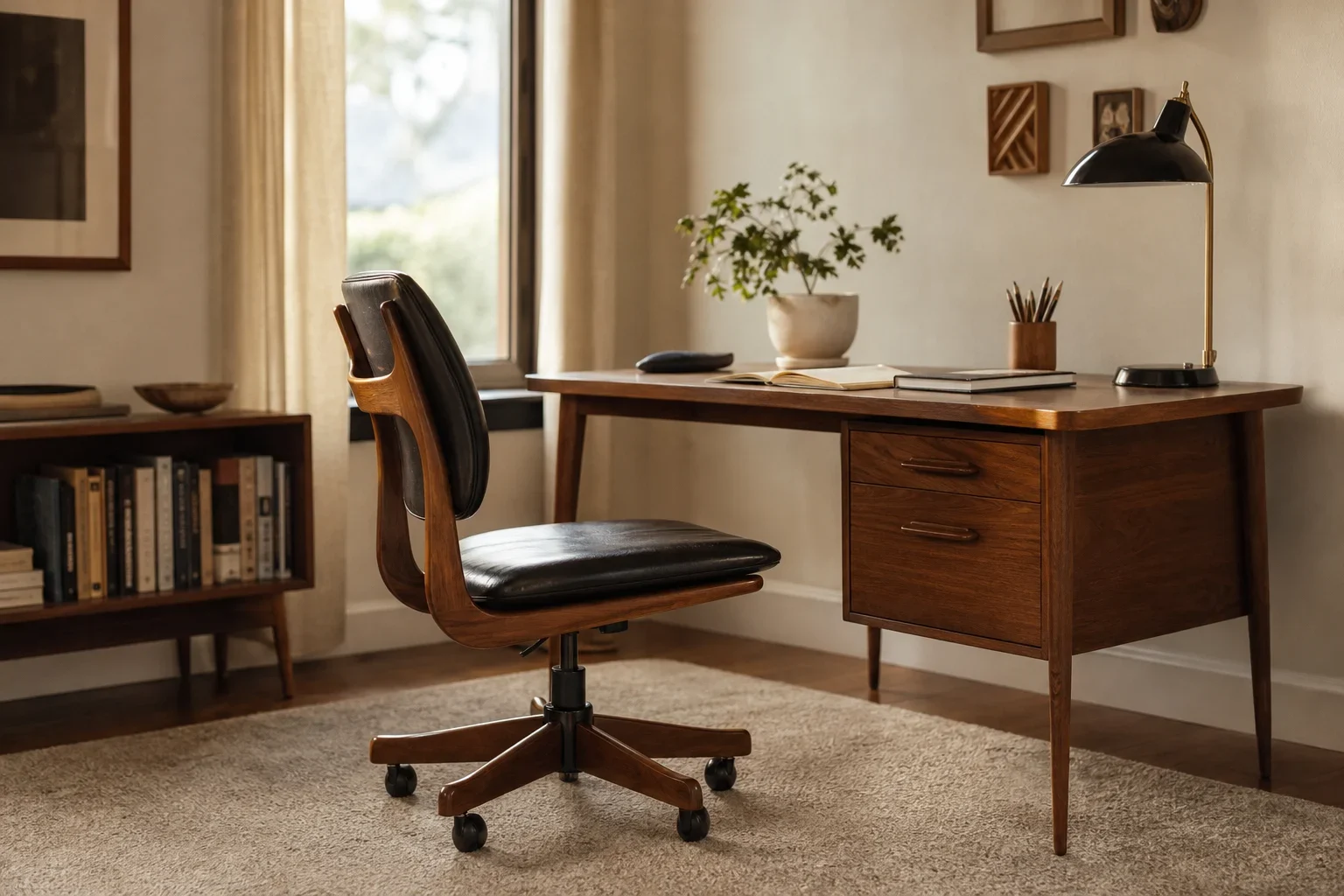
- Joinery: dovetailed or mortise-and-tenon joints suggest period-appropriate construction; stapled boxes suggest a shortcut.
- Secondary wood: solid wood drawer interiors versus particle board or MDF in a load-bearing area.
- Maker's marks: a label or stamp inside a drawer or on the underside is useful corroborating evidence, but on its own it isn't proof — it should match the construction and materials you're seeing.
- Wear logic: wear should sit at desk edges, drawer pulls, and leg bottoms, not spread evenly across the whole surface.
- Fit for purpose: once you've checked authenticity, measure the writing surface and clearance for your monitor, keyboard, and cable routing — a beautiful 1960s desk that's too shallow for a modern monitor arm will frustrate you daily.
If a desk passes the authenticity checks and fits your actual desk setup, it's a reasonable candidate for a vintage or licensed-reissue purchase. If it only passes on looks, a budget-inspired desk with the same tapered-leg, low-profile silhouette will likely serve you better day to day.
Chair track: let ergonomics lead, treat vintage charm as a bonus
Task chairs are the one mid-century modern category where most people are better served defaulting toward a reproduction or a budget-inspired piece, for a simple reason: original 1950s–1970s office seating wasn't engineered for eight-hour days at a laptop, and foam, webbing, and swivel mechanisms that are 50-plus years old are among the first things to fail even on an otherwise well-preserved piece. If you do want a vintage or licensed chair, check it the way you'd check any upholstered piece — original foam that's crumbling is a real-use problem, not just a cosmetic one, and reupholstery with period-appropriate fabric can be a reasonable fix without destroying value.
For a true daily-use task chair, it's worth being honest with yourself: a design-inspired reproduction with modern lumbar support and a tested swivel base will usually outperform an untouched vintage chair for comfort, even if the vintage piece wins on story and resale interest.
Worked example: furnishing a one-corner home office
This is a hypothetical walkthrough to illustrate the filter, not a real client case or a price quote.
Imagine a reader furnishing a single work corner in a first apartment. They find a walnut writing desk at an estate sale with dovetailed drawers, solid wood drawer sides, and a maker's stamp that matches a known 1960s manufacturer — it passes every desk-track check, and the writing surface is deep enough for their monitor setup. That desk is a strong candidate to buy as-is.

Mid-century modern product idea: HUANUO FlowLift™ Pro Monitor Arm for 13–32" Screens, MechaSpring Monitor Mount, Fully-Adjustable Monitor Stand with Tilt/Swivel/Rotation, Tool-Free VESA Mount, C-Clamp/Grommet Base, Max Load 15.4 lbs. This pairs directly with the 'fit for purpose' step in the desk track, where the guide flags that a shallow vintage writing surface can frustrate a modern monitor setup — mounting the screen on an adjustable arm instead of setting it directly on the desktop frees up surface depth and lets an otherwise-authentic vintage desk still work for daily video calls and typing.
For the chair, the same seller has a vintage swivel chair from the same era, but the foam is collapsed and the mechanism sticks. Rather than restoring a chair they'll use daily, the reader decides the desk is their one authentic anchor piece for the room, and looks for a budget-inspired task chair with a similar tapered-leg silhouette and better back support — keeping the vintage spend focused on the piece that didn't need a trade-off.
Finding the budget-inspired match once you've decided
Once you know which piece in your home office corner is worth buying vintage and which should be a reproduction or budget-inspired stand-in, the next step is finding the actual product. Nido's AI-matched picks surface real, in-stock furniture sized to your rooms and your budget, so you can fill the chair slot with something that fits the desk's style without hunting listing by listing. If you'd rather describe what you need in plain language — "a mid-century style task chair under my desk budget" — Ask Nido turns that question into a shoppable list.
Frequently asked questions
Is it ever worth buying a vintage office chair for daily use?
It can be, if the frame, swivel mechanism, and foam are in genuinely sound condition and you've tested it in person. But original foam from the 1950s–1970s commonly needs replacement, and a sticking or worn mechanism is a real comfort problem, not just a cosmetic one — so inspect the working parts, not just the finish, before committing a daily-use chair to a vintage purchase.
How can I tell if a mid-century modern desk is authentic versus a modern copy?
Check the joinery first: hand-cut dovetails with slightly irregular spacing suggest period construction, while stapled or nailed drawer boxes are a common reproduction shortcut. Then check the secondary wood inside drawers — solid pine, poplar, or birch supports an authentic attribution, while particle board or MDF in a structural role is a strong sign of later production. A maker's mark is useful corroborating evidence but shouldn't be trusted on its own.
Mid-century modern product idea: Soft Modern Geometric Abstract Large Machine Washable 5x7 Area Rug. A geometric area rug is a practical way to visually anchor a single work corner within a larger room without touching the authenticity question at all — since the article's filter is about the desk and chair specifically, a washable rug in a mid-century-adjacent pattern is a lower-risk way to reinforce the look around them.
What's the difference between a licensed reissue and a reproduction desk or chair?
A licensed reissue is produced by the original manufacturer or an authorized successor and should be priced and marketed accordingly, while an unlicensed reproduction copies the look without that authorization and is sometimes sold deceptively as vintage. Neither is inherently better for daily use than the other, but the distinction matters if provenance or resale value is part of why you're buying.
Should I prioritize authenticity or ergonomics for a task chair?
For a chair you'll sit in for work hours every day, ergonomics should generally come first. Vintage office seating from the mid-century period wasn't designed around modern desk setups, and worn foam or mechanisms can undermine comfort even on an otherwise well-preserved piece — so treat authenticity as a bonus feature on a chair, not the deciding factor.
What wood and materials should I expect in a genuine mid-century desk?
Walnut, teak, oak, and rosewood were common primary woods in quality mid-century case pieces, often paired with solid pine, poplar, or birch for drawer interiors and internal frames. Particle board or MDF in a structural role is inconsistent with genuine 1950s–1970s construction and is a common marker of a later reproduction.
Can I mix a vintage desk with a budget-inspired chair in the same corner?
Yes — treating one piece as your authentic anchor and the other as a budget-inspired stand-in is a practical way to control spend without sacrificing the look of the room. The worked example above shows this approach: a vintage desk that passed every construction check, paired with a new chair chosen for support rather than provenance.
Shop the Mid-century modern look
As an Amazon Associate, Nido earns from qualifying purchases.

Dawnwake Mushroom Lamp Table Lamp for Bedroom-Small Desk Table Lamps,Orange
A compact table lamp like this is a reasonable finishing touch for the work corner once you've settled the desk-versus-chair decision: its small footprint keeps it from competing with a writing surface you've already measured for monitor and keyboard clearance, and a warm accent light is the kind of low-stakes, budget-inspired addition the article recommends reserving for pieces that don't need an authenticity check.
View on Amazon
HUANUO FlowLift™ Pro Monitor Arm for 13–32" Screens, MechaSpring Monitor Mount, Fully-Adjustable Monitor Stand with Tilt/Swivel/Rotation, Tool-Free VESA Mount, C-Clamp/Grommet Base, Max Load 15.4 lbs
This pairs directly with the 'fit for purpose' step in the desk track, where the guide flags that a shallow vintage writing surface can frustrate a modern monitor setup — mounting the screen on an adjustable arm instead of setting it directly on the desktop frees up surface depth and lets an otherwise-authentic vintage desk still work for daily video calls and typing.
View on Amazon
Soft Modern Geometric Abstract Large Machine Washable 5x7 Area Rug
A geometric area rug is a practical way to visually anchor a single work corner within a larger room without touching the authenticity question at all — since the article's filter is about the desk and chair specifically, a washable rug in a mid-century-adjacent pattern is a lower-risk way to reinforce the look around them.
View on Amazon