How to Tell If Mid-Century Modern Furniture Is Real: The Five-Test Checklist
Design theme: Mid-century modern
A five-test checklist for how to tell if mid-century modern furniture is real, with a go/no-go scoring rule and a worked example you can copy at an estate sale or online listing.
As an Amazon Associate, Nido earns from qualifying purchases.
Most guides to mid-century modern furniture explain the signals — dovetails, patina, maker's marks — and then stop, leaving you to guess how many signals are enough. This guide turns those signals into a portable five-test checklist for how to tell if mid-century modern furniture is real, with a simple pass/fail rule you can run in person or against online listing photos before you spend a first-apartment budget on a single piece.
Run the same five tests every time, in the same order, whether you're standing over a credenza at an estate sale or scrolling a marketplace listing at midnight. Consistency is what turns a hunch into a decision.
How to tell if mid century modern furniture is real: the five-test checklist
Each test below focuses on one category of evidence. No single test is decisive on its own — authentication guides consistently note that labels, wear, and materials should be weighed together rather than trusted individually.
Test 1: Joinery and construction
Open every drawer and flip the piece if you can. Look for hand-cut or machine-cut dovetail joints on drawer boxes — both are consistent with quality mid-century production, but stapled or nailed drawer boxes are a strong reproduction signal. On chairs and tables, check for mortise-and-tenon joints at the legs; wiggle the legs and base rails to feel for looseness. Peek at the drawer sides, bottom, and back: solid secondary wood such as pine, poplar, or birch is period-appropriate, while particle board or MDF in a structural role on a piece claimed to be from the 1950s–1970s is a red flag, since those materials weren't used in quality furniture before the 1980s.
Test 2: Materials and weight
Pick the piece up, or ask the seller for its weight. Solid wood and quality plywood are noticeably heavier than modern engineered wood, so a credenza or dresser that feels surprisingly light is worth a second look. Check the wood species too — solid teak, rosewood, and walnut were widely used in the era, and high-quality rosewood pieces in particular are almost always pre-1975 given later restrictions on the material. Run a hand across the grain: genuine solid wood shows irregular grain, while veneer over a different core often repeats in a way that becomes obvious on close inspection.
Test 3: Wear and patina
Authentic age shows up unevenly, in places that match how the piece was actually used. Chair legs wear at the base and stress points, drawer handles wear where fingers grip, tabletop edges soften and round slightly. Reproductions are sometimes "distressed" evenly across the whole surface, which doesn't match real use. Original brass hardware develops a layered patina rather than a uniformly bright or uniformly dull finish, and original lacquer often yellows slightly and develops fine micro-cracking with age.
Mid-century modern product idea: Bme Georgina Sideboard 2 Doors & 3 Drawers, Mid Century, Teak Brown, 61". If you're running the five-test checklist and want a benchmark for what balanced mid-century proportions and door/drawer rhythm look like, a new sideboard in this style can be a useful side-by-side reference before you go compare it against joinery, wear, and details on a vintage credenza or dresser you're evaluating.
Test 4: Maker's marks and labels
Check the underside, the back, and inside drawers for stamps, paper labels, or foil stickers, and compare anything you find against documented examples for that maker before treating it as proof. A label alone is not sufficient — labels can be removed, replaced, or reproduced — so treat a mark as one data point that should agree with the construction and materials, not as a stand-alone verdict. The absence of a label doesn't disqualify a piece either, since many original items were sold without prominent branding.
Test 5: Proportions and design details
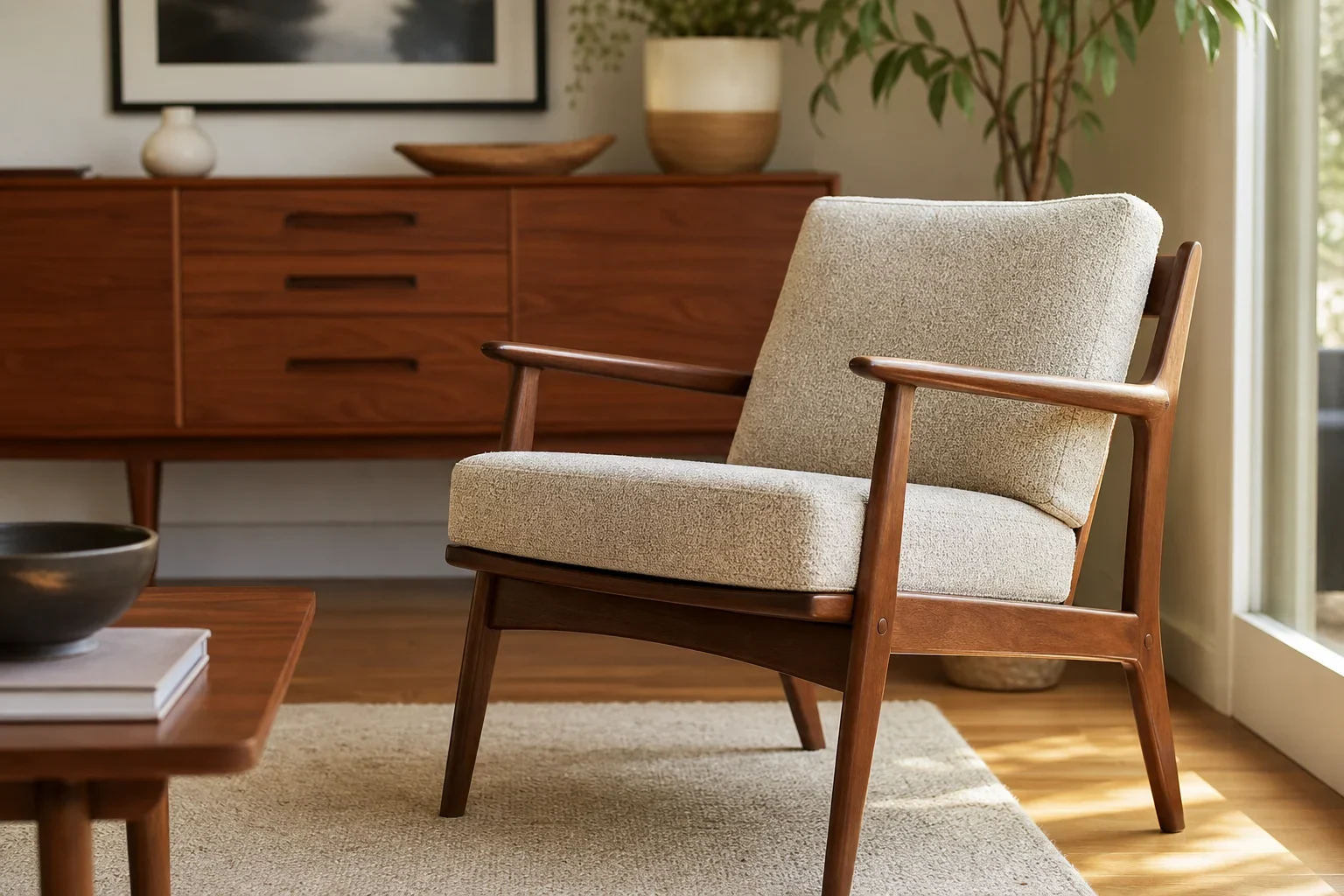
Compare the piece against known examples of the design: tapered or splayed legs, low horizontal profiles, and restrained ornamentation are typical of the era, but reproductions sometimes exaggerate these cues — legs too sharply angled, bodies too bulky — to read as "retro" from a distance. A design that feels balanced from every angle, with legs, handles, and drawer rhythm all working together, is a better sign than any single flashy detail.
Score it: a simple go/no-go rule
Treat this as a checklist, not a single test. A reasonable rule of thumb: if a piece passes at least four of the five tests, it's reasonable to buy it as a vintage original at vintage pricing. If it passes two or three, price it as an uncertain piece and negotiate accordingly, or plan to enjoy it as a nice used piece rather than a documented original. If it fails on construction or materials — particle board in a structural role, stapled drawers, suspiciously light weight — walk away regardless of what the label claims, since construction is the hardest thing for a reproduction to fake convincingly. For anything priced above roughly $1,000, it's also worth a specialist opinion before you commit a chunk of a first-apartment budget to one piece.
Worked example: a hypothetical teak credenza listing
The following is a hypothetical scenario to illustrate how the five tests work together — not a real transaction.
Imagine a marketplace listing for a "1960s Danish teak credenza," photographed with the doors open and one drawer pulled out. Running the checklist against the photos: Joinery — the drawer shows visible dovetail joints, pass. Materials — the seller's description notes the piece is heavy and required two people to move, and the wood grain looks irregular rather than repeating, pass. Wear — the door pulls show smoothed, shinier wear exactly where hands would grip, and the top has slight edge softening, pass. Marks — no visible label in the photos, so this test is inconclusive rather than a fail. Proportions — the tapered legs and low, horizontal case look consistent with published Danish credenza designs from the period, pass. That's four clear passes and one inconclusive, which under the go/no-go rule supports treating it as a likely original and pricing it accordingly — with a follow-up question to the seller asking for a close-up photo of the underside before paying a vintage premium.
Once you've decided a piece is worth a vintage price, the full vintage-vs-reproduction-vs-budget-inspired buying filter walks through how to make that call category by category across an entire first apartment. Nido's room-by-room planning can help you decide which room that credenza belongs in and what else it needs to sit alongside, while Nido's budget tracker can flag whether a vintage splurge on one piece means defaulting to budget-inspired picks elsewhere to stay on plan.
Mid-century modern product idea: Evolur Stilnovo Mid Century Dresser, in Sugar Cane. As with the sideboard, having a contemporary dresser that reads as mid-century in silhouette can help you practice Test 5 — comparing tapered legs, low horizontal lines, and restrained ornamentation — against a piece you're trying to authenticate, without treating the new piece itself as a vintage stand-in.
Frequently asked questions
What if a piece passes only some of the five tests?
Treat a partial pass as a pricing signal rather than a clean answer. If a piece passes construction and materials but the marks are inconclusive, it's reasonable to buy it as a likely original at a modest discount rather than full vintage price, or to simply enjoy it as a well-made used piece without paying a collector premium.
Can I run this checklist from online listing photos alone?
Partially. Wear patterns, proportions, and visible joinery often show up clearly in good photos, but weight and the feel of the wood grain are hard to judge remotely. When photos are inconclusive, ask the seller directly for close-ups of the underside, drawer interiors, and any labels before you buy sight unseen.
Does a maker's label guarantee a piece is authentic?
No. Labels can be removed, replaced, or reproduced, so a label should be treated as one piece of evidence that needs to agree with the construction and materials — not as proof on its own. The absence of a label doesn't rule out authenticity either, since many original pieces were sold without prominent branding.
Is a refinished vintage piece automatically less authentic?
Refinishing doesn't change whether a piece was originally produced in the mid-century era, but it can hide some of the evidence you'd otherwise use to authenticate it, like original patina or finish crazing. A refinished piece can still pass the joinery, materials, and proportions tests even if the wear test is harder to read.
What's the difference between a licensed reissue and an unlicensed reproduction?
A licensed reissue is currently produced by the original manufacturer or an authorized successor and is typically priced well below a vintage original, while an unlicensed reproduction copies the look without authorization and is sometimes misrepresented as vintage. Both can be well made — the issue is honest pricing and description, not just quality.

Mid-century modern product idea: Antique Brass zinc Alloy Cabinet pulls,Vintage Retro 5 Inch (128mm) Hole Center Cabinet Handles for Drawer,Cupboard, Wardrobe,Dresser - 6 Pack. Since Test 3 in the checklist centers on how original brass hardware develops uneven, layered patina versus a uniformly bright or dull finish, having a set of new reproduction-style pulls on hand gives you a visual contrast point when examining a vintage piece's handles for authentic wear.
How much should I spend authenticating a lower-cost piece?
Match your effort to the price. A quick five-test check is worth doing on almost anything, but paying for a specialist opinion generally only makes sense above roughly $1,000, where getting the tier wrong costs real money.
Further reading: How to Authenticate Mid-Century Modern Furniture: Full Guide.
Further reading: How to Tell if Furniture Is Genuine Mid Century Modern.
Further reading: What Is Mid-Century Modern Furniture? Years & Key Traits.
Further reading: How to Identify Genuine Mid Century Modern Furniture (Real vs. Fake).
Shop the Mid-century modern look
As an Amazon Associate, Nido earns from qualifying purchases.

Bme Georgina Sideboard 2 Doors & 3 Drawers, Mid Century, Teak Brown, 61"
If you're running the five-test checklist and want a benchmark for what balanced mid-century proportions and door/drawer rhythm look like, a new sideboard in this style can be a useful side-by-side reference before you go compare it against joinery, wear, and details on a vintage credenza or dresser you're evaluating.
View on Amazon
Evolur Stilnovo Mid Century Dresser, in Sugar Cane
As with the sideboard, having a contemporary dresser that reads as mid-century in silhouette can help you practice Test 5 — comparing tapered legs, low horizontal lines, and restrained ornamentation — against a piece you're trying to authenticate, without treating the new piece itself as a vintage stand-in.
View on Amazon
Antique Brass zinc Alloy Cabinet pulls,Vintage Retro 5 Inch (128mm) Hole Center Cabinet Handles for Drawer,Cupboard, Wardrobe,Dresser - 6 Pack
Since Test 3 in the checklist centers on how original brass hardware develops uneven, layered patina versus a uniformly bright or dull finish, having a set of new reproduction-style pulls on hand gives you a visual contrast point when examining a vintage piece's handles for authentic wear.
View on Amazon