Mid-Century Modern Rug: Vintage vs. Reproduction — A Buying Filter for First Apartments
Design theme: Mid-century modern
A practical filter for the mid century modern rug vintage vs reproduction decision: how to read construction, wear, and labels, plus a worked example for anchoring a room.
As an Amazon Associate, Nido earns from qualifying purchases.
Rugs do not behave like case goods. There is no drawer to pull apart, no dovetail to inspect, no maker's stamp burned into the underside of a tabletop. That is what makes the mid century modern rug vintage vs reproduction decision trickier than deciding on a credenza or a lounge chair, and it is a gap most authentication guides skip entirely, since they are written for wood and joinery, not pile and weave. This guide adapts the same underlying authentication logic, construction, materials, wear, and documentation, to the one category in an MCM room that is hardest to judge from a listing photo.
If you have not already, start with the hub guide on choosing vintage, licensed reissue, or budget-inspired furniture piece by piece. This article picks up where that one leaves off, focused entirely on the rug under your coffee table.
Why rugs need their own filter
Furniture authentication leans on joinery, screw types, and secondary wood, details that are physically hard to fake at scale. Rugs do not have joints. Instead, the same forensic mindset gets applied to different evidence: how the piece was constructed on a loom, what it is made of, and how it has actually aged. The principle carries over even though the material does not. Construction methods are consistently described as the most reliable authentication tool because they are tied closely to how and when a piece was actually produced, and that logic holds whether you are looking at a drawer box or a woven backing.
A construction-first filter for mid century modern rugs: vintage vs reproduction
Work through these five checks in order. Each one narrows the decision a little further.
Mid-century modern product idea: Mohawk Home Non Slip Rug Pad 8' x 10' - 1/4" Thick Felt + Latex Rubber Gripper - Dual Surface Cushion for Hardwood, Carpet, Tile Floors, Made in USA. Whichever rug a reader ends up choosing, vintage or reproduction, a pad underneath protects both the floor and the rug itself from shifting and friction wear. This matters especially for the construction checks in this guide: a pad that keeps a rug flat and anchored helps preserve the fringe and pile evidence you're relying on to judge age, rather than letting daily foot traffic add new, misleading wear on top of whatever history the rug already has.
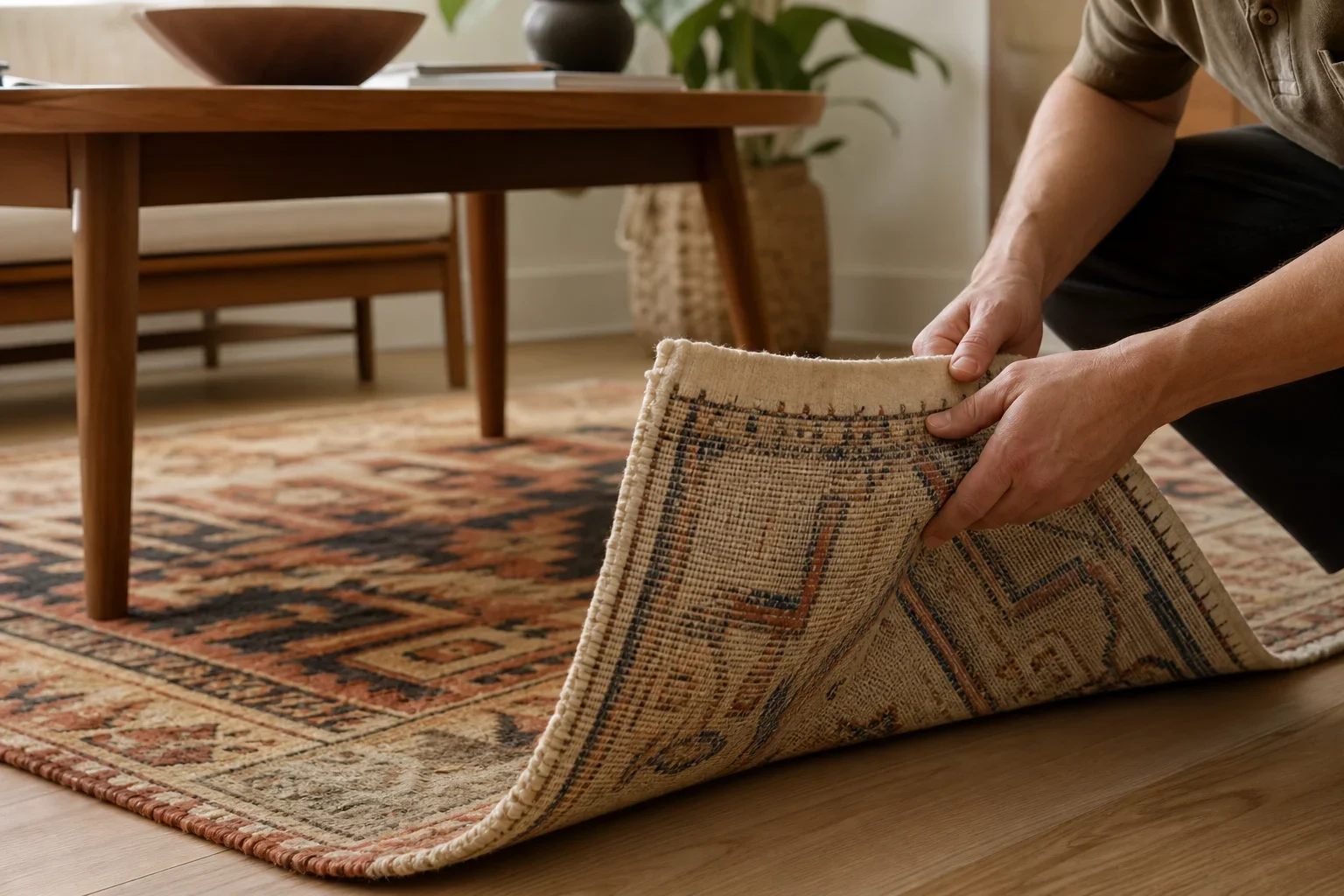
- Check the back of the rug. Turn it over before anything else. A hand-knotted construction shows individual knots and some irregularity from row to row. A machine-tufted or power-loomed reproduction usually shows a uniform grid and often a visible backing fabric or latex coating holding the pile in place. This is the rug equivalent of checking joinery before anything else, it is the detail a casual copy is least likely to get right.
- Look at the fringe. On many hand-knotted pieces, the fringe is a continuation of the foundation threads, not a separate piece. Fringe that is obviously stitched or glued onto the edge afterward is a signal worth weighing alongside everything else, the same way a stapled drawer box is treated as one clue among several rather than final proof on its own.
- Read the wear honestly. Authentic age tends to show up unevenly, flattened pile where feet and furniture legs have pressed on it for years, lighter color where sun exposure was greatest, and less wear in corners and under furniture. If the fading or wear looks suspiciously even across the whole surface, that is a pattern more consistent with artificial distressing than with decades of real use.
- Check labels, selvage marks, or dealer tags. A label or tag can support an attribution, but it should not be the whole case. The same caution that applies to furniture maker's marks applies here: a label should be corroborated by what the piece is actually made of and how it was actually built, not trusted on its own.
- Weigh the price against the claim. A rug priced well below what a genuinely hand-knotted, decades-old piece typically commands is worth a second look rather than a quick purchase, the same instinct that applies to any vintage furniture deal that seems too easy.
For anything priced high enough to sting if you are wrong, a specialist opinion, a rug-focused dealer or appraiser rather than a general antiques generalist, is worth the modest cost before you commit, and keeping any receipt, listing screenshot, or seller correspondence gives you a record to fall back on later.
Worked example: anchoring a living room with one rug decision
Here is a hypothetical to make the filter concrete, not a real transaction, just a worked-through scenario. Imagine a first apartment living room with a budget-inspired sofa and a reproduction coffee table, both chosen for fit and function rather than provenance. The rug is the one piece doing the work of tying the room's palette together, so it is worth spending the filter's five checks on before deciding.
Option A is a machine-made reproduction in a Scandinavian-inspired geometric pattern, consistent color, no fringe irregularities, a visible woven backing. Option B is a hand-knotted wool piece from an estate listing, photographed with some pile flattening near the edges and a partial selvage tag that does not fully match any documented maker. Running the filter: Option A is honest about what it is and low-risk either way. Option B needs the wear and construction checks taken seriously before it earns a vintage price, the flattening and uneven color support age, but the incomplete label means it should not be priced as if it were fully documented. In this hypothetical, the sensible move is to treat Option B as probably vintage but not fully provenanced, and negotiate accordingly, rather than paying full vintage price on the label alone.
Matching the rug to your room, not just your rulebook
Once you know which tier you are buying in, the harder question is often which pattern and palette actually suit the room. A short style quiz can narrow that down before you start scrolling listings, so you are not comparing a Danish-leaning geometric against a Californian-leaning organic shape with no sense of which one is actually yours. From there, matching real, in-stock options to your rooms and budget is a faster way to compare a reproduction rug's price against what a vintage equivalent would cost for the same visual effect, so the vintage-vs-reproduction decision gets made against your actual numbers instead of a guess.
Mid-century modern product idea: LYNCOHOME 43.3'' Fluted Lift Top Coffee Table with Storage,Modern Oval Coffee Table for Living Room or Home Office(Walnut). The article's worked example centers on a first apartment living room built around a coffee table and a rug meant to tie the palette together. An oval, fluted-front coffee table in walnut gives readers a concrete, budget-inspired anchor piece to picture the rug choice against, since the guide explicitly treats the table as a design-fit purchase rather than one requiring authentication.
Frequently asked questions
How can I tell if a mid-century rug is hand-knotted or machine-made?
Turn the rug over and look at the back. Hand-knotted construction shows individual knots with some natural irregularity row to row; machine-tufted or power-loomed rugs usually show a uniform grid pattern and often a visible backing material. This mirrors how construction and joinery are treated as the most reliable authentication signal for furniture, hard to fake convincingly at scale.
Does a worn or faded rug always mean it is vintage?
Not necessarily, but the pattern of wear matters. Genuine age tends to show up unevenly, flattened pile under furniture legs, fading concentrated where sunlight actually hit the rug, while uniformly distributed wear or color loss is more consistent with artificial distressing than decades of real use. Treat even wear as a reason to look harder at construction and labels, not as a disqualifier on its own.
Are rug labels or selvage marks reliable proof of age?
A label or tag is a useful clue but not proof by itself. The same logic that applies to furniture maker's marks applies here: a label should be corroborated by the rug's actual construction and materials, since labels can be inconsistent, incomplete, or simply attached to a different piece than the one being sold.
Mid-century modern product idea: Dimmable Floor Lamp for Living Room, 65" Tall Metal Standing Lamp with LED Bulb, Mid Century Modern Arc Floor Lamp with Linen Shade for Bedroom, Reading Room, Office & Nursery, Gold and Walnut Color. Good lighting is what actually lets you see the construction and wear details this guide asks readers to check, uneven fading, flattened pile, fringe irregularities. An arc floor lamp placed near the seating area gives the kind of direct, adjustable light that makes examining a rug's back and edges far easier than relying on overhead fixtures, while its described mid-century styling keeps it visually consistent with the room being planned.
Is it ever better to buy a reproduction mid-century rug than a vintage one?
Often, yes, especially for a first apartment. A well-made reproduction is a low-risk, budget-friendly way to get the look without needing to authenticate anything, and it is a reasonable default for a room where the rug is not the piece you are trying to make a design statement with. Save the vintage hunt and the extra scrutiny for the room where the rug is doing real visual work.
When should I get a vintage rug professionally assessed?
If the asking price is high enough that being wrong would genuinely hurt, a specialist opinion is worth the cost before you commit, the same threshold used for high-value vintage furniture. Keep any receipt, listing screenshot, or seller correspondence as part of the record, since documentation helps both your own decision now and any future resale.
How do I decide which rug pattern actually fits my room?
Start with your own style before the listings, not after. A short style quiz can clarify which mid-century sub-aesthetic you are actually drawn to, and matching that against real, in-stock, budget-fitted options makes it easier to compare a reproduction rug's price directly against a vintage equivalent for the same room.
Shop the Mid-century modern look
As an Amazon Associate, Nido earns from qualifying purchases.
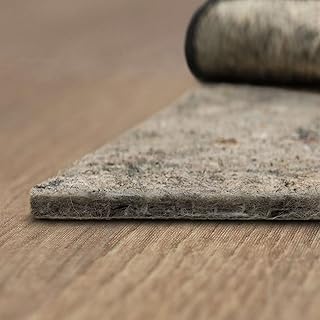
Mohawk Home Non Slip Rug Pad 8' x 10' - 1/4" Thick Felt + Latex Rubber Gripper - Dual Surface Cushion for Hardwood, Carpet, Tile Floors, Made in USA
Whichever rug a reader ends up choosing, vintage or reproduction, a pad underneath protects both the floor and the rug itself from shifting and friction wear. This matters especially for the construction checks in this guide: a pad that keeps a rug flat and anchored helps preserve the fringe and pile evidence you're relying on to judge age, rather than letting daily foot traffic add new, misleading wear on top of whatever history the rug already has.
View on Amazon
LYNCOHOME 43.3'' Fluted Lift Top Coffee Table with Storage,Modern Oval Coffee Table for Living Room or Home Office(Walnut)
The article's worked example centers on a first apartment living room built around a coffee table and a rug meant to tie the palette together. An oval, fluted-front coffee table in walnut gives readers a concrete, budget-inspired anchor piece to picture the rug choice against, since the guide explicitly treats the table as a design-fit purchase rather than one requiring authentication.
View on Amazon
Dimmable Floor Lamp for Living Room, 65" Tall Metal Standing Lamp with LED Bulb, Mid Century Modern Arc Floor Lamp with Linen Shade for Bedroom, Reading Room, Office & Nursery, Gold and Walnut Color
Good lighting is what actually lets you see the construction and wear details this guide asks readers to check, uneven fading, flattened pile, fringe irregularities. An arc floor lamp placed near the seating area gives the kind of direct, adjustable light that makes examining a rug's back and edges far easier than relying on overhead fixtures, while its described mid-century styling keeps it visually consistent with the room being planned.
View on Amazon