Storage Ottoman Instead of Coffee Table: A Small Apartment Placement Guide
Design theme: Minimalist
Thinking about a storage ottoman instead of a coffee table in a small apartment? Here's the clearance math, a worked example, and a checklist to test before you buy.
As an Amazon Associate, Nido earns from qualifying purchases.
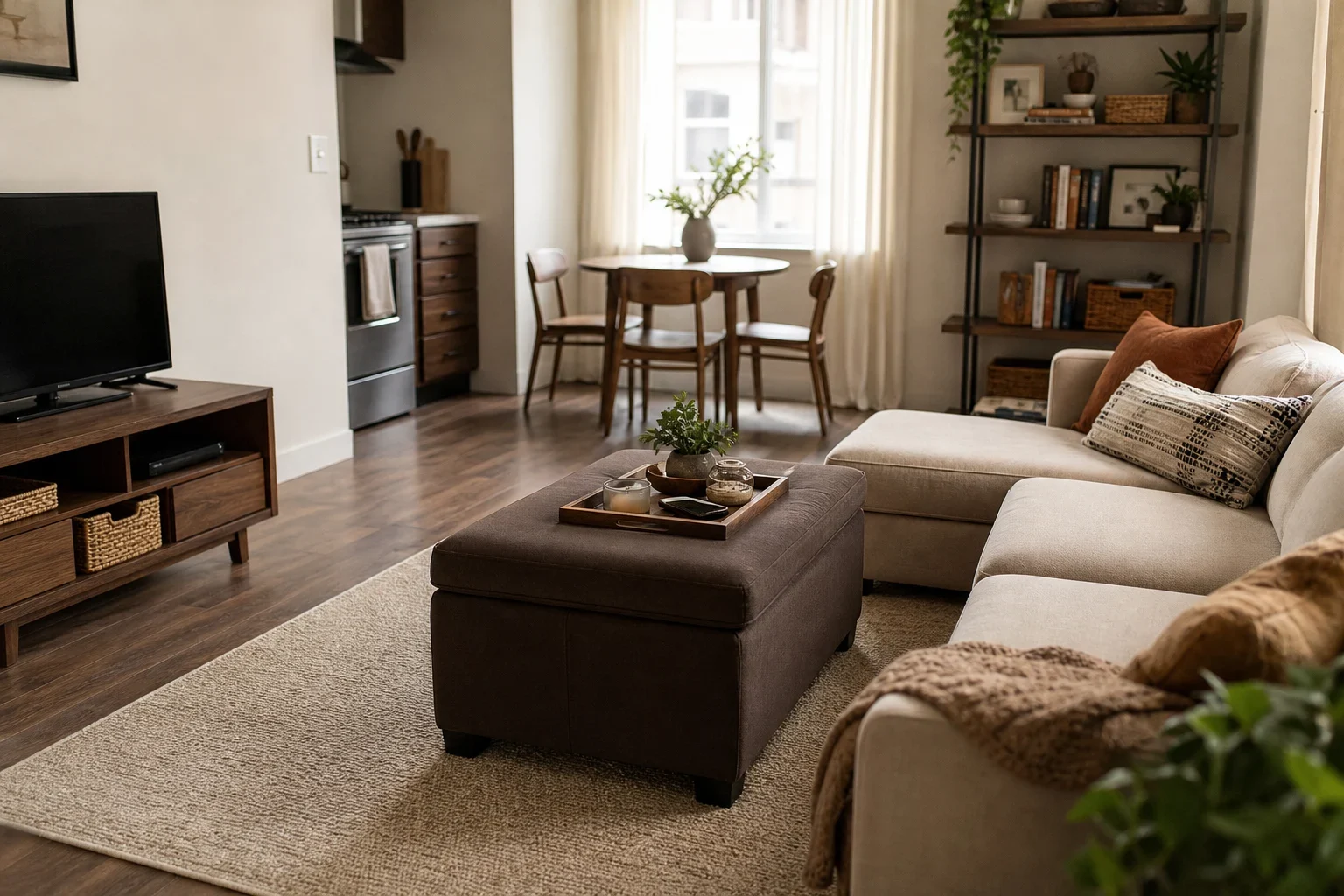
If your living room feels tight the moment you walk a friend through it, the coffee table is often the first thing worth questioning. Swapping a storage ottoman instead of a coffee table in a small apartment can win back walkway inches while giving you a lid that opens into hidden storage — but only if you place it using the same clearance math you'd use for any other piece. This guide walks through that math with a labeled worked example, plus a checklist you can run against your own room before you order anything.
Why a storage ottoman instead of a coffee table can help a small apartment
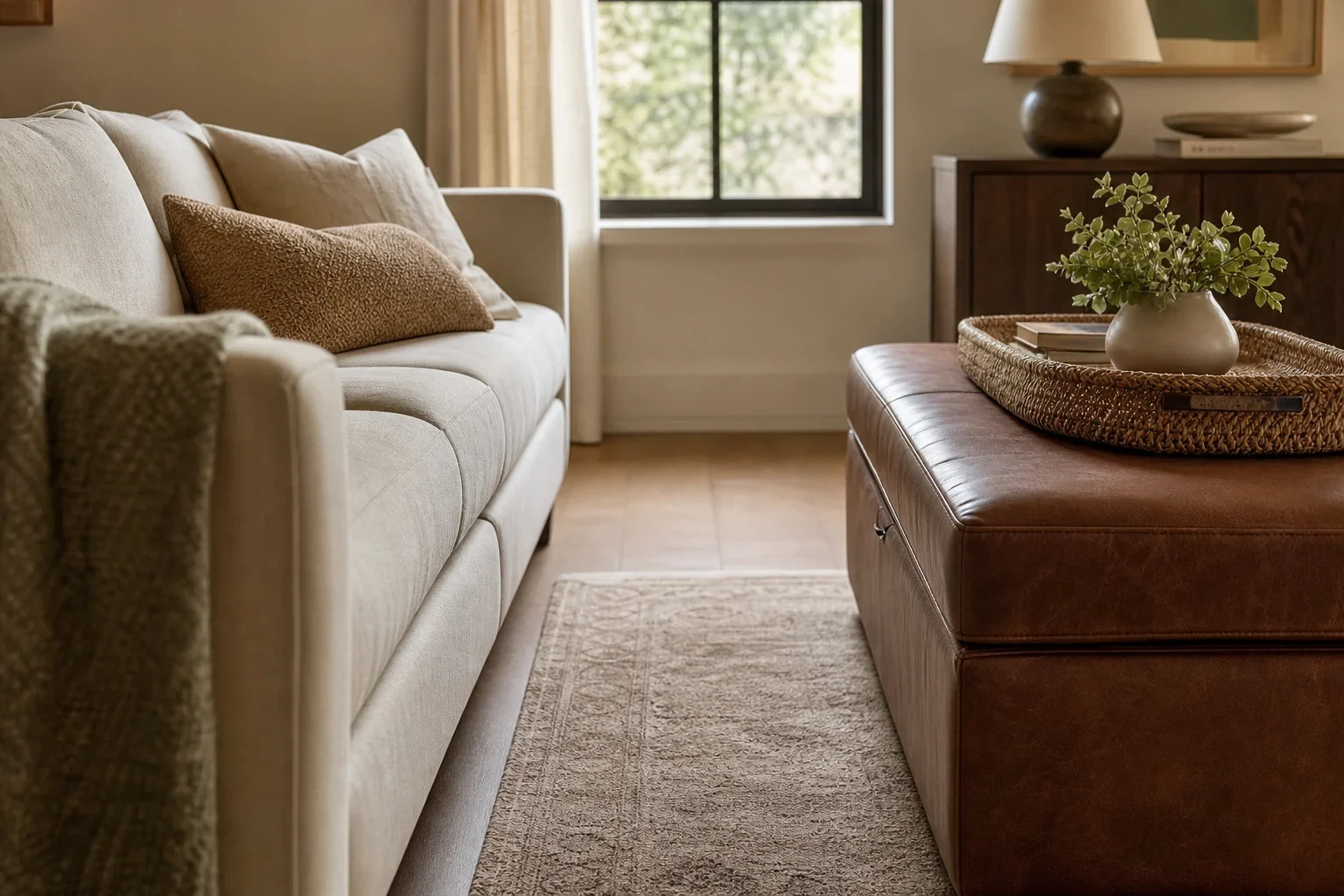
A hard-edged coffee table and a softer-sided storage ottoman can occupy almost the same footprint on paper, but they behave differently in daily use. An ottoman has no sharp corners to navigate around, its lid can double as a seat or a tray surface, and many versions use the same depth as a coffee table while tucking storage underneath rather than spreading it onto open shelving. None of that matters, though, if you don't first confirm the swap actually preserves your walking path — which is the real decision this guide is built around.
The clearance numbers this decision depends on
Furniture-layout guidance commonly cites about 18 inches of clearance between a sofa and a coffee table (or ottoman) for comfortable legroom and reach, with 30 to 36 inches recommended for the main walkway through a living room — 36 inches for primary paths, 30 inches as a workable minimum for secondary routes. These aren't Nido-specific numbers; they're widely used living-room layout benchmarks, and they're the baseline you should measure your own room against before deciding whether an ottoman swap is worth it.
A worked example: hypothetical 10×12 ft living room
The following is a hypothetical walkthrough, not a real client layout — use it to see how the math works, then run your own numbers.
Minimalist product idea: DUMOS 43 Inch Foldable Storage Ottoman Bench, Large Ottoman with Storage. Before ordering a piece like this, run the checklist in this guide: measure its 43-inch footprint against your current coffee table's depth, confirm the lid needs clear space to open without hitting the sofa, then mark where it would actually sit and re-check your walkway. A foldable design may also simplify testing different placements since it can be collapsed and moved while you experiment with the 18-inch sofa gap and 30-36 inch walkway targets described above.
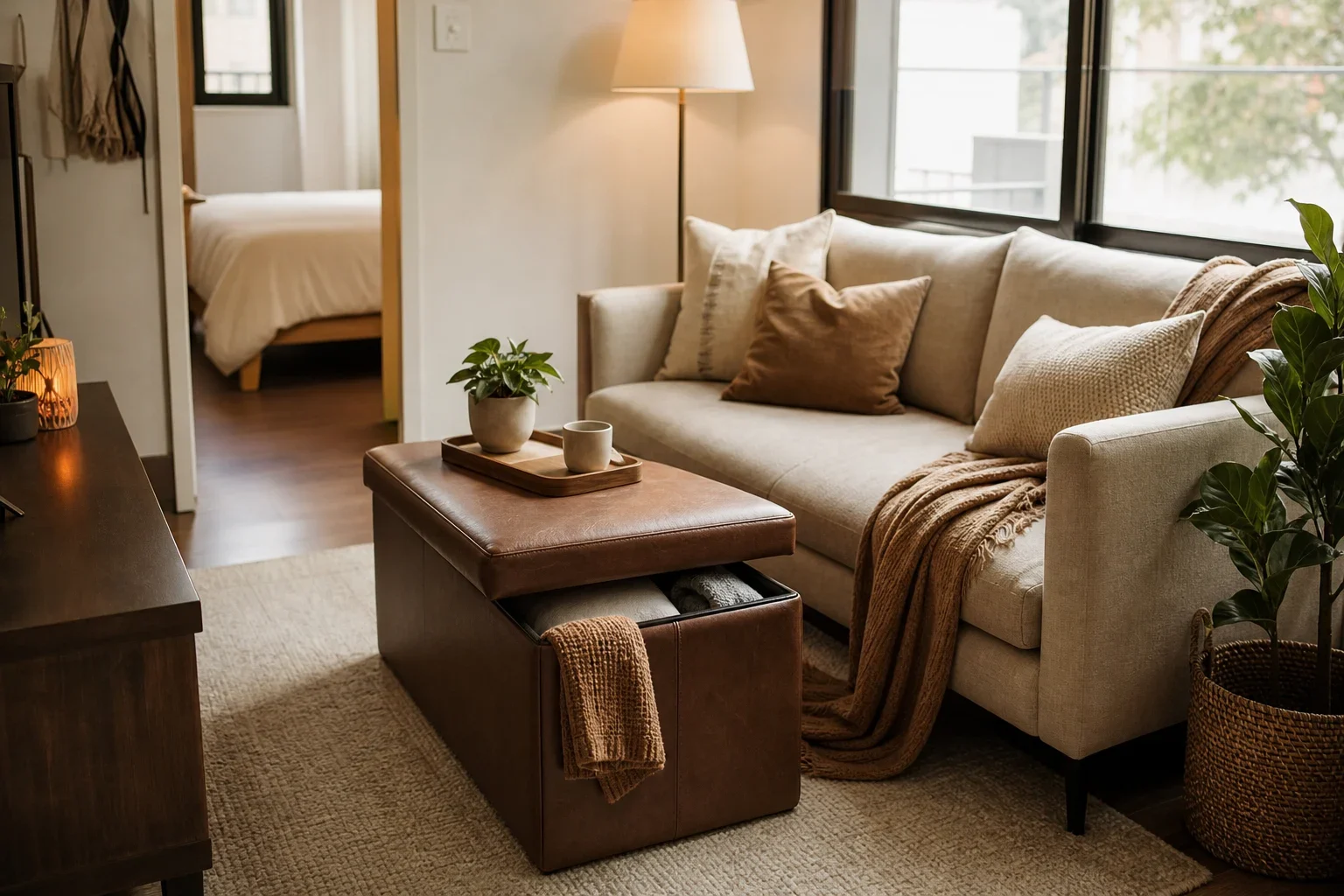
Imagine a 10-foot by 12-foot living room with a 78-inch sofa against the long wall and a single walkway running from the entry to the hallway on the opposite side.
- Sofa to seating-zone edge: sofa depth 36 inches, placed against the wall, leaving roughly 108 inches of remaining room depth.
- Coffee table (original plan): a 48-inch by 24-inch coffee table set 18 inches from the sofa front consumes 24 inches of depth plus the 18-inch gap — 42 inches total.
- Remaining walkway: 108 minus 42 leaves 66 inches, which comfortably clears the 36-inch primary-walkway target with room to spare for a side chair.
- Now add a side chair: if a 30-inch-deep accent chair is placed across the walkway, the clear path drops to 36 inches — right at the primary-walkway minimum, with no slack for a door swing or a recliner footrest.
- Swap to a storage ottoman: a 36-inch square ottoman set at the same 18-inch gap consumes 18 inches less depth than the rectangular coffee table in this hypothetical, because its lid can sit slightly closer to the sofa without blocking reach, and because many ottomans are shallower front-to-back than a typical coffee table of similar width.
- Net result: the ottoman swap can return several inches to the walkway in this hypothetical — potentially the difference between a 30-inch pinch point and a 36-inch comfortable path once a chair is added.
The numbers above are illustrative, not a guarantee for your specific furniture — an ottoman that's deeper than a coffee table, or placed with less gap, could just as easily shrink your walkway instead of winning it back. The point of the worked example is the method: measure the swap before you buy it, not after.
Checklist: should you make the swap?
- Measure your sofa-to-table gap as it stands today — is it close to 18 inches, tighter, or looser?
- Measure your main walkway at its narrowest point, including any chair, door swing, or radiator that intrudes on it.
- Compare the ottoman's footprint (and lid height, if you plan to use it as a surface) against your current coffee table's footprint — don't assume smaller-looking means smaller depth.
- Check whether the ottoman's storage lid needs extra clearance to open fully without hitting the sofa or table.
- Re-measure the walkway with the ottoman's position marked — not just its footprint, but where it will actually sit day to day.
- Only commit once the recalculated walkway meets at least 30 inches, and ideally 36 inches, for your main path.
What an ottoman swap doesn't fix
A storage ottoman changes clearance math and adds hidden storage, but it won't fix a layout where the sofa itself is oversized for the room, or where a door swing and a walkway already compete for the same floor space. If your room fails the clearance check even after the swap, the next move is usually resizing or repositioning the sofa itself, not choosing a different coffee-table substitute.
How Nido can help you plan the swap
Nido's room-by-room planning tool lays out every piece a room needs — including seating and storage — so you can test a storage ottoman against your actual room dimensions before you commit to buying one. And because furnishing decisions always compete with a budget, Nido's budget tracker keeps the swap in view alongside everything else you're planning to buy, so a storage upgrade doesn't quietly push another room over budget.
Minimalist product idea: MAXYOYO Modern Accent Chair, Comfy Living Room Chair with Metal Frame. This is the kind of accent chair the worked example warns about — adding one across a walkway can shrink your clear path from a comfortable 66 inches down to the 36-inch minimum. Before placing a chair like this near your ottoman swap, measure its depth and test its position against the same clearance checklist, since a metal-framed accent chair's footprint still counts fully toward your walkway math even if it looks visually light.
Frequently asked questions
Is a storage ottoman a good coffee table replacement in a small apartment?
It can be, provided the swap is measured rather than assumed. An ottoman's soft edges and underneath storage are genuine advantages in a small room, but the deciding factor is whether its footprint, once placed with a proper sofa-to-ottoman gap, still leaves your main walkway at or above the commonly cited 30–36 inch range.
How much space should I leave between a sofa and a storage ottoman?
Living-room layout guidance generally points to about 18 inches between a sofa and a coffee table or ottoman for comfortable legroom and reach — the same target applies whether the piece is a hard-topped table or a storage ottoman, since both occupy the same functional zone in front of the seating.
What's the minimum walkway width I need to keep clear?
Most living-room layout references recommend 36 inches for a primary walkway and treat 30 inches as a workable minimum for secondary paths. Anything narrower tends to force single-file movement or sideways turning, which is the clearest sign a layout needs adjusting.
Minimalist product idea: Round Fluted End Table, 17.7'' Mid Century Modern Side Table, Circle Bedside Tables Drink Table Wood Nightstand for Small Spaces, Living Room (Walnut-1PCS). A compact 17.7-inch round side table can sit beside a storage ottoman without competing for the same floor depth the ottoman and walkway need, since its small footprint is easy to tuck against a sofa arm rather than inline with the main path. When testing your layout, measure this table's placement separately from the ottoman's footprint so it doesn't quietly eat into the clearance you just won back.
Can a storage ottoman be too big for a small living room?
Yes. A deep or oversized ottoman can consume as much — or more — floor depth than the coffee table it's replacing, especially once you account for lid clearance if it opens upward. Always measure the ottoman's actual footprint against your current table rather than assuming a storage piece is automatically more compact.
Should I measure the room before or after choosing the ottoman?
Measure first. Record your sofa position, the existing sofa-to-table gap, and your walkway's narrowest point before you shop, then compare any ottoman you're considering against those numbers. This avoids the common failure mode where a piece looks right in a photo but doesn't leave enough clearance once it's in your actual room.
Does floating the sofa away from the wall change this math?
It can. If you pull the sofa away from the wall to create a walkway behind it, that reduces the depth available in front of the sofa for the ottoman and the main walkway, so you'll need to re-run the clearance check with the sofa's new position rather than reusing your wall-hugging measurements.
Shop the Minimalist look
As an Amazon Associate, Nido earns from qualifying purchases.

DUMOS 43 Inch Foldable Storage Ottoman Bench, Large Ottoman with Storage
Before ordering a piece like this, run the checklist in this guide: measure its 43-inch footprint against your current coffee table's depth, confirm the lid needs clear space to open without hitting the sofa, then mark where it would actually sit and re-check your walkway. A foldable design may also simplify testing different placements since it can be collapsed and moved while you experiment with the 18-inch sofa gap and 30-36 inch walkway targets described above.
View on Amazon
MAXYOYO Modern Accent Chair, Comfy Living Room Chair with Metal Frame
This is the kind of accent chair the worked example warns about — adding one across a walkway can shrink your clear path from a comfortable 66 inches down to the 36-inch minimum. Before placing a chair like this near your ottoman swap, measure its depth and test its position against the same clearance checklist, since a metal-framed accent chair's footprint still counts fully toward your walkway math even if it looks visually light.
View on Amazon
Round Fluted End Table, 17.7'' Mid Century Modern Side Table, Circle Bedside Tables Drink Table Wood Nightstand for Small Spaces, Living Room (Walnut-1PCS)
A compact 17.7-inch round side table can sit beside a storage ottoman without competing for the same floor depth the ottoman and walkway need, since its small footprint is easy to tuck against a sofa arm rather than inline with the main path. When testing your layout, measure this table's placement separately from the ottoman's footprint so it doesn't quietly eat into the clearance you just won back.
View on Amazon