Rug Size for a Small Living Room with Visible Furniture Legs: A Checklist
Design theme: Minimalist
A step-by-step worksheet for picking the right rug size in a small living room when your sofa, chairs, and coffee table have visible legs — plus a worked example.
As an Amazon Associate, Nido earns from qualifying purchases.
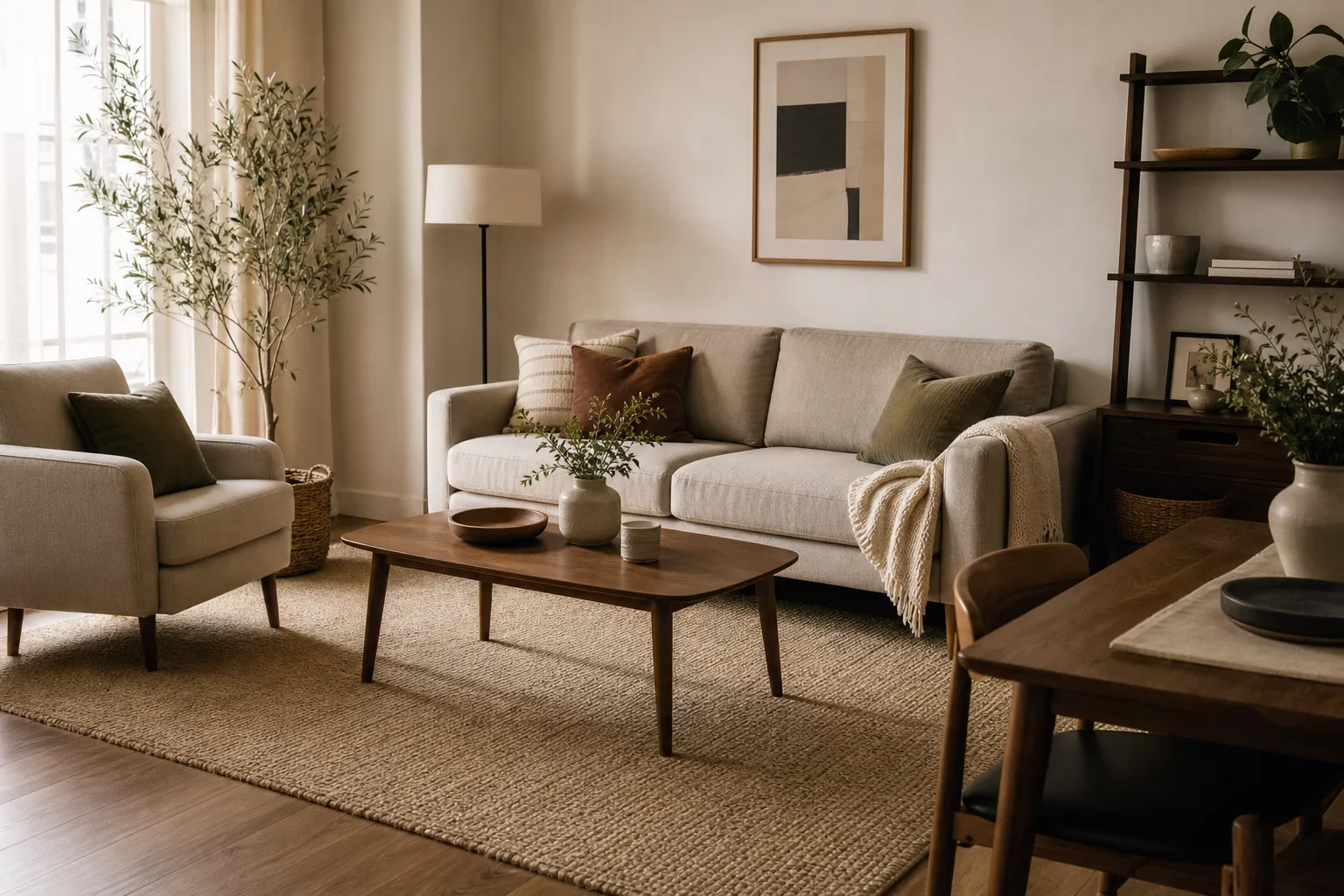
Figuring out the right rug size for a small living room gets trickier once you start caring about visible furniture legs. Legs that show daylight under the sofa are one of the simplest tricks for making a tight room feel bigger, but if the rug stops short of those legs — or swallows the whole floor — the effect backfires and the room reads as pieced-together instead of planned. This guide walks through a short worksheet for measuring your seating area, deciding how many legs should sit on the rug, and leaving the right buffer at the walls, so you can order a rug that actually fits before furniture shows up.
Why rug size and visible furniture legs are a package deal
A rug's job is to anchor a seating group into one visual zone. When a sofa, chairs, and coffee table all have exposed legs rather than a floor-skimming skirt, your eye follows the floor line underneath them — and a too-small rug breaks that line right where it matters most. Guidance on rug sizing generally recommends extending the rug 15 to 25 inches wider than the sofa on each side, with roughly 12 to 18 inches of visible floor between the rug's edge and the wall in a smaller room. That border is what keeps a rug from looking like an island, and it's also the space where your eye registers continuous floor under leggy furniture.
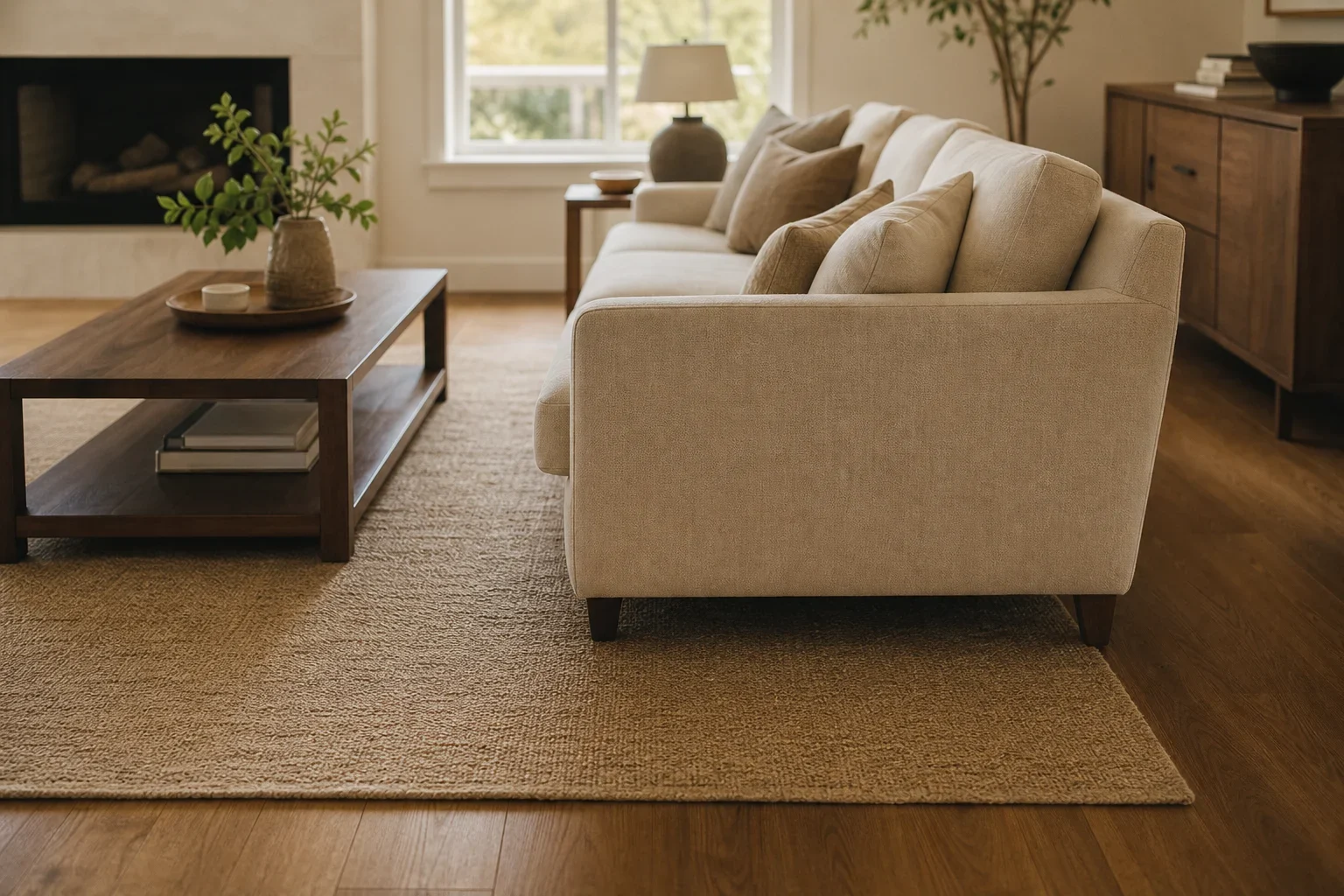
Separately, raising furniture off the floor on visible legs is one of the most-cited ways to make a small room read larger, because an unbroken floor sightline and reduced shadow under the furniture both expand how spacious the room feels. A correctly sized rug supports that effect by giving the eye a consistent surface to travel across, instead of a patchwork of bare floor, rug edge, and furniture shadow.
The two placement rules that decide your rug size
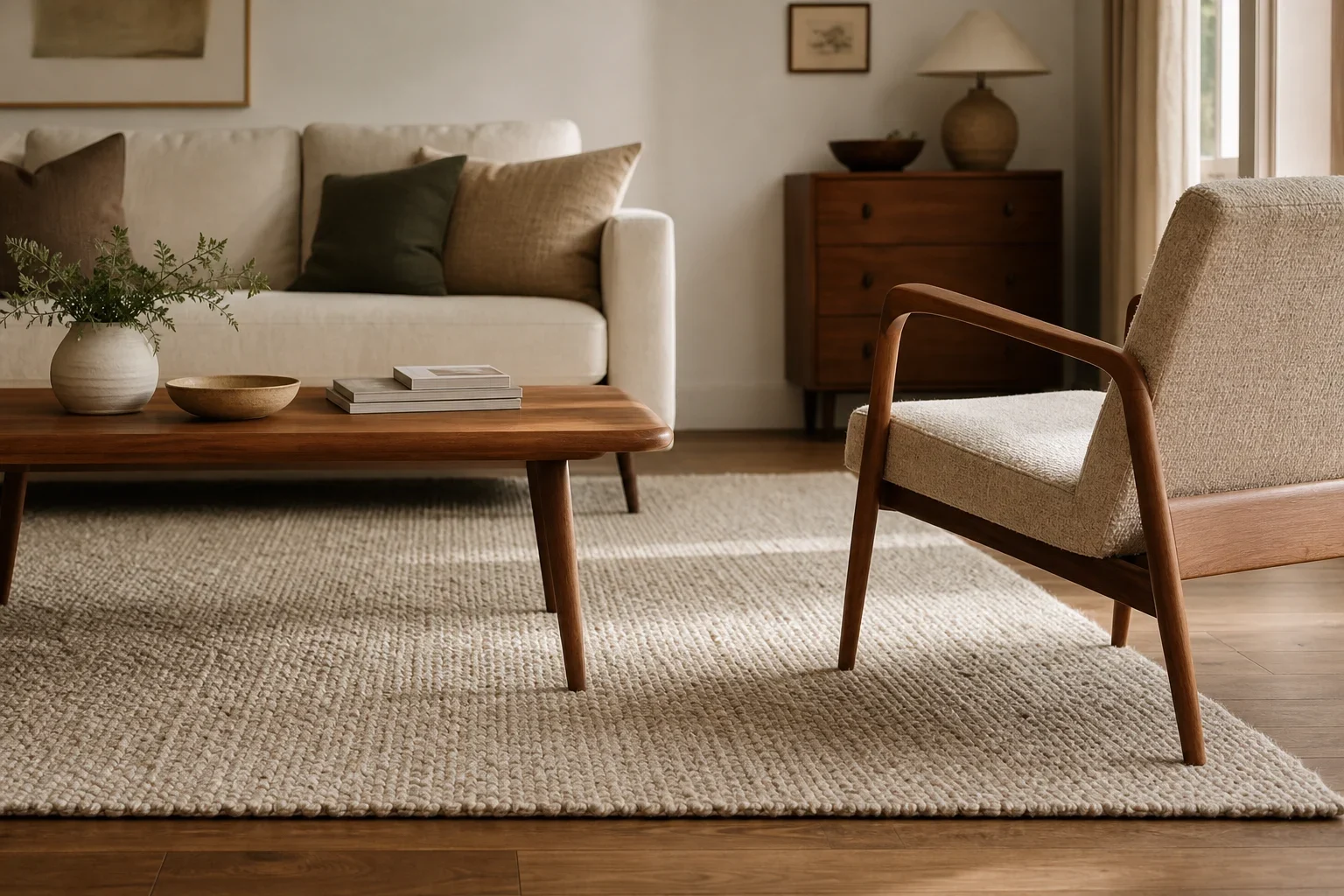
Most living-room rug guidance comes down to two placement strategies: either the front legs of your sofa and chairs sit on the rug, or every leg does. The front-legs-only approach is the more forgiving option for small apartments — it still anchors the group without needing a rug that stretches wall to wall. The all-legs-on approach gives the most finished, grounded look but needs a bigger room and a bigger rug to pull off without crowding the walkway.
Minimalist product idea: 5x7 Washable Rugs Non Slip Minimalist Area Rug for Bedroom Soft Low Pile Solid Color Large Bedroom Throw Carpet Stain Resistant Classic Neutral Area Rug Plain Boho Rugs for Kitchen Nursery, Ivory. A 5x7 rug is a useful reference point when running the worksheet's width-buffer math for a loveseat or small sofa footprint, since you can measure the 5-foot and 7-foot dimensions against your taped-out seating group to see whether a front-legs-on or all-legs-on approach actually fits. Its low pile and solid, neutral coloring also support a minimalist room by keeping the floor reading as one continuous plane rather than adding pattern that competes with the clean sightline visible furniture legs are meant to create.
Rug size for a small living room with furniture legs: the worksheet
Work through these four steps before you shop, ideally with painter's tape on the floor rather than guessing from a listing photo.
- Measure the seating footprint. Record your sofa's width and depth, the depth of any chairs facing it, and the gap you want between the sofa and coffee table. A commonly cited minimum for that sofa-to-coffee-table gap is about 18 inches, so legroom doesn't disappear once the rug goes down.
- Pick front-legs-on or all-legs-on. If your room is under roughly 10 by 12 feet, front-legs-on is usually the safer call — it needs a shorter rug and leaves more floor for the walkway. All-legs-on works better once the room is large enough to still leave a full walking path after the bigger rug is placed.
- Add the width buffer. For front-legs-on, add roughly 6 to 12 inches of rug beyond each side of the sofa. For all-legs-on, plan for the rug to run the full width of the seating group plus a few inches past the outermost legs on each side, since the goal is for every leg to sit confidently on the rug rather than at its very edge.
- Check the wall buffer and the walkway together. Leave roughly 12 to 18 inches of bare floor between the rug's outer edge and the wall where space allows. Then walk the room: if the rug pushes your main path below a comfortable walking clearance, you've chosen a rug that's too big for this room, not too small.
Worked example: a hypothetical 10×12 studio living corner
This is a hypothetical walkthrough to illustrate the math, not a real client floor plan. Imagine a studio with a 10-foot-wide living corner holding a 72-inch sofa with 6-inch tapered legs, one accent chair, and a coffee table set 18 inches off the sofa.
- Step 1: Sofa width 72 inches, chair adds roughly 30 inches of depth to one side of the grouping, coffee table gap 18 inches as planned.
- Step 2: Given the 10-foot wall, front-legs-on is the better fit here rather than trying to get all legs of the sofa and chair onto one large rug.
- Step 3: Adding an 8-inch buffer on each side of the 72-inch sofa suggests a rug roughly 88 inches wide — close to a standard size that would need checking against the retailer's actual dimensions before buying.
- Step 4: After placing that rug, the hypothetical room still needs to keep roughly 3 feet clear between the coffee table and the nearest wall or hallway entrance for comfortable movement. If taping out the rug shows less than that, the next size down — or a shift in furniture placement — solves it before the rug arrives.
The exact inches will shift with your own sofa and chair dimensions, but the sequence — measure the seating group, choose a placement rule, add the buffer, then confirm the walkway — holds for any small living room.
Rug size starting points by seating width
Use this as a rough starting point, then confirm with your own tape measure and the worksheet above, since sofa depth, leg height, and room shape all shift the right call.
Minimalist product idea: Honyee Morden Coffee Table, 42.5" x 28.5" x 16.1" Triangle Tempered Glass Top for Living Room, Color: Natural Wood. Because this coffee table's footprint (42.5 x 28.5 inches) is a fixed, listed dimension, it's a handy anchor point when working through Step 1 of the worksheet — measuring the seating footprint and confirming the roughly 18-inch sofa-to-table gap before you tape out rug size. Its glass top and simple triangular profile keep the piece visually light, which fits a minimalist layout where the goal is letting floor and rug show through rather than having bulky furniture break the sightline.
| Seating width | Likely rug approach | What to watch |
|---|---|---|
| Loveseat or small sofa, under 65 inches | Front-legs-on, modest rug | Keep enough buffer that the rug doesn't crowd a nearby dining or work zone |
| Standard sofa, 65–85 inches | Front-legs-on in tight rooms; all-legs-on if the room allows | Recheck the walkway after the rug is down, not just before |
| Sofa plus one or two chairs | All-legs-on only if wall length and floor space support it | A too-small rug under a multi-piece group often looks worse than no rug at all |
Turning the worksheet into a shopping list
Once you know the rug dimensions your layout can actually support, Nido's room-by-room planning checklist can hold that measurement alongside the rest of your living room list, so the rug decision doesn't get made in isolation from the sofa, coffee table, and storage pieces around it. If you'd rather describe the room than browse endless rug listings, Nido's AI picks can surface real, in-stock rugs sized to the dimensions and budget you've already worked out.
Frequently asked questions
Do all the sofa legs need to sit on the rug?
No. Front-legs-on is a widely used and more space-efficient approach for smaller rooms — only the front legs of the sofa and any chairs rest on the rug, while the back legs can stay off. All-legs-on gives a more finished look but needs enough floor space to still leave a comfortable walkway after the larger rug is placed.
How much rug should show beyond the sofa?
A commonly used range is roughly 6 to 12 inches of rug extending past each side of the sofa, with some guidance suggesting up to 15 to 25 inches in larger rooms for a more generous frame. In a small living room, staying toward the smaller end of that range usually keeps the rug from eating into your walkway.
What happens if I size the rug too small?
A rug that's noticeably smaller than the seating group tends to look disconnected from the furniture rather than anchoring it, and it can undercut the benefit of visible furniture legs, since the floor line breaks at the rug's edge instead of continuing smoothly. If you're torn between two sizes, sizing up slightly within your walkway limits is usually the safer call.
Minimalist product idea: MAXYOYO Modern Accent Chair, Comfy Living Room Chair with Metal Frame. An accent chair with a metal frame is exactly the kind of exposed-leg piece the article's worksheet is built around, since its placement determines whether a front-legs-on or all-legs-on rug approach makes sense in a small room. The slim metal frame keeps the chair visually light, supporting the minimalist goal of an uninterrupted floor line under and around the seating group once the rug size is chosen.
Why does rug size matter more when furniture has visible legs?
Furniture with exposed legs lets light and floor show underneath it, which is part of what makes a small room feel larger. A correctly sized rug supports that effect by giving your eye a continuous surface under and around the furniture; a mismatched rug interrupts that sightline and can cancel out the benefit of choosing leggy furniture in the first place.
How do I check the walkway after placing a rug?
Tape out the rug's footprint on the floor along with your planned furniture positions, then physically walk your main path — to the hallway, kitchen, or front door. If you have to turn sideways or step around the rug's edge, the rug or the furniture layout needs to shift before you buy, since clearance guidance generally treats a cramped main walkway as a sign the layout needs adjusting.
Can I use a smaller rug just under the coffee table instead?
A coffee-table-only rug can work in a genuinely tight room where a full seating-group rug isn't realistic, but it's generally considered the hardest size to get right, since furniture can end up looking like it's floating around the rug rather than grounded by it. It's worth trying the front-legs-on approach first if your room has even a little more space to work with.
Shop the Minimalist look
As an Amazon Associate, Nido earns from qualifying purchases.
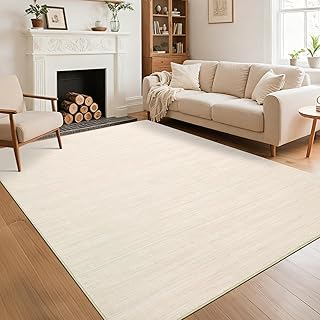
5x7 Washable Rugs Non Slip Minimalist Area Rug for Bedroom Soft Low Pile Solid Color Large Bedroom Throw Carpet Stain Resistant Classic Neutral Area Rug Plain Boho Rugs for Kitchen Nursery, Ivory
A 5x7 rug is a useful reference point when running the worksheet's width-buffer math for a loveseat or small sofa footprint, since you can measure the 5-foot and 7-foot dimensions against your taped-out seating group to see whether a front-legs-on or all-legs-on approach actually fits. Its low pile and solid, neutral coloring also support a minimalist room by keeping the floor reading as one continuous plane rather than adding pattern that competes with the clean sightline visible furniture legs are meant to create.
View on Amazon
Honyee Morden Coffee Table, 42.5" x 28.5" x 16.1" Triangle Tempered Glass Top for Living Room, Color: Natural Wood
Because this coffee table's footprint (42.5 x 28.5 inches) is a fixed, listed dimension, it's a handy anchor point when working through Step 1 of the worksheet — measuring the seating footprint and confirming the roughly 18-inch sofa-to-table gap before you tape out rug size. Its glass top and simple triangular profile keep the piece visually light, which fits a minimalist layout where the goal is letting floor and rug show through rather than having bulky furniture break the sightline.
View on Amazon
MAXYOYO Modern Accent Chair, Comfy Living Room Chair with Metal Frame
An accent chair with a metal frame is exactly the kind of exposed-leg piece the article's worksheet is built around, since its placement determines whether a front-legs-on or all-legs-on rug approach makes sense in a small room. The slim metal frame keeps the chair visually light, supporting the minimalist goal of an uninterrupted floor line under and around the seating group once the rug size is chosen.
View on Amazon