Furniture With Legs for a Small Apartment: A Visible-Leg Shopping Checklist
Design theme: Mid-century modern
Shopping for a small apartment? Use this checklist to choose sofas, coffee tables, and ottomans with visible legs so more floor shows and the room feels larger.
As an Amazon Associate, Nido earns from qualifying purchases.
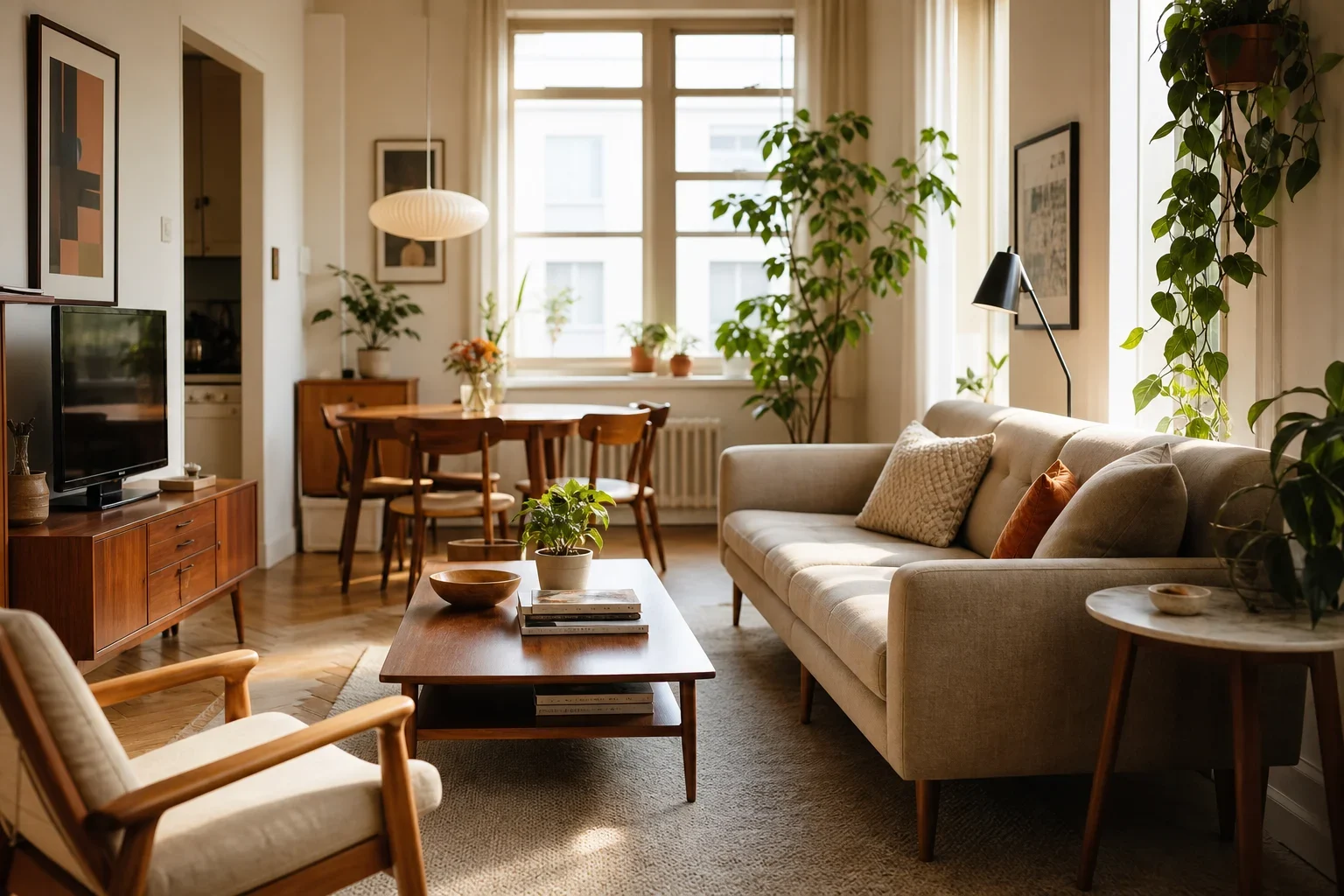
If you're choosing furniture with legs for a small apartment, you're looking for a simple, repeatable filter you can apply at every furniture decision — not just the sofa. Visible legs let light and floor show underneath a piece instead of stopping at its base, and that uninterrupted sightline is one of the easiest ways to make a tight room read as more open, without rearranging a single thing you already own.
This guide turns that one principle into a checklist you can carry through your next four purchases: sofa, coffee table, storage ottoman, and side or console table. It pairs with the broader layout rules in Nido's small-apartment furnishing hub, which covers walkway clearance and floating-furniture decisions — this piece zooms in on the shopping filter for legs specifically.
Why furniture with legs matters in a small apartment
A sofa, ottoman, or console that sits flush on the floor — through a skirt, a boxy base, or hidden casters — creates a visual stopping point. Your eye reads the furniture's edge as the end of the floor, even if there's open space beyond it. One furniture-industry guide focused on small-room perception explains that tall legs let your eye continue across the floor underneath a piece, so the floor appears to extend further toward the wall, and that light passing under the furniture avoids the dark shadow band that low-skirted pieces create along the bottom edge.
A separate furniture-fit guide aimed at small city apartments lists "furniture with visible legs makes rooms feel larger by showing more floor" as one of its core small-space tactics, alongside measuring doorways and leaving walkway clearance. The takeaway for shopping: when two pieces are otherwise similar in size and price, the one with exposed legs is usually the better pick for a tight room.
The visible-leg shopping checklist
Work through this list at the point of purchase — in a showroom, on a product page, or while comparing options with Nido's AI picks. For each category, look past the fabric and color straight to the base.
Mid-century modern product idea: Tbfit 77.2" W Linen Sofa Couch, Mid Century Modern Decor Loveseat Couches for Living Room, Button Tufted Upholstered Small Couch for Bedroom, Solid, and Easy to Install Love Seats Furniture, Beige. When shopping for the sofa anchor in the checklist, use this loveseat as a candidate to inspect at the base rather than the fabric: confirm whether the skirt (if any) can be removed or whether the legs sit exposed, since the guide's whole point is that an otherwise similar sofa reads lighter when floor shows underneath it. Its mid-century styling fits the article's broader aesthetic, but treat the actual leg visibility as something to verify on the product listing or in person before counting it as a visible-leg pick.
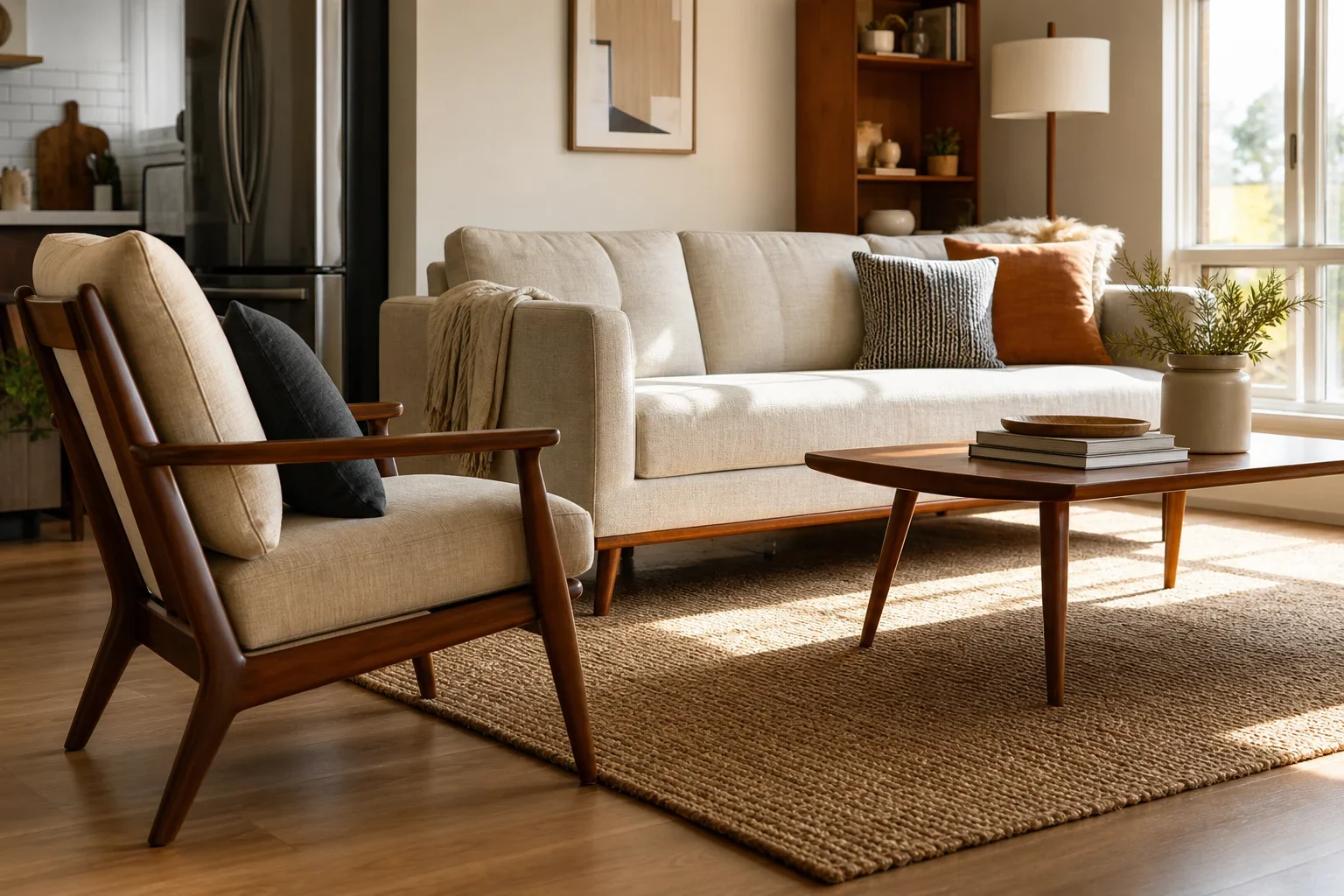
- Sofas and loveseats: Check whether the fabric skirt covers the legs. If it does, either skip the piece or confirm the skirt can be removed. Look for legs in the 4–8 inch range — one guide to small-room furniture notes that 6–8 inches is the sweet spot for maximizing floor visibility without the piece looking perched. Tapered or hairpin legs show the most floor; block legs add back some visual weight even at the same height.
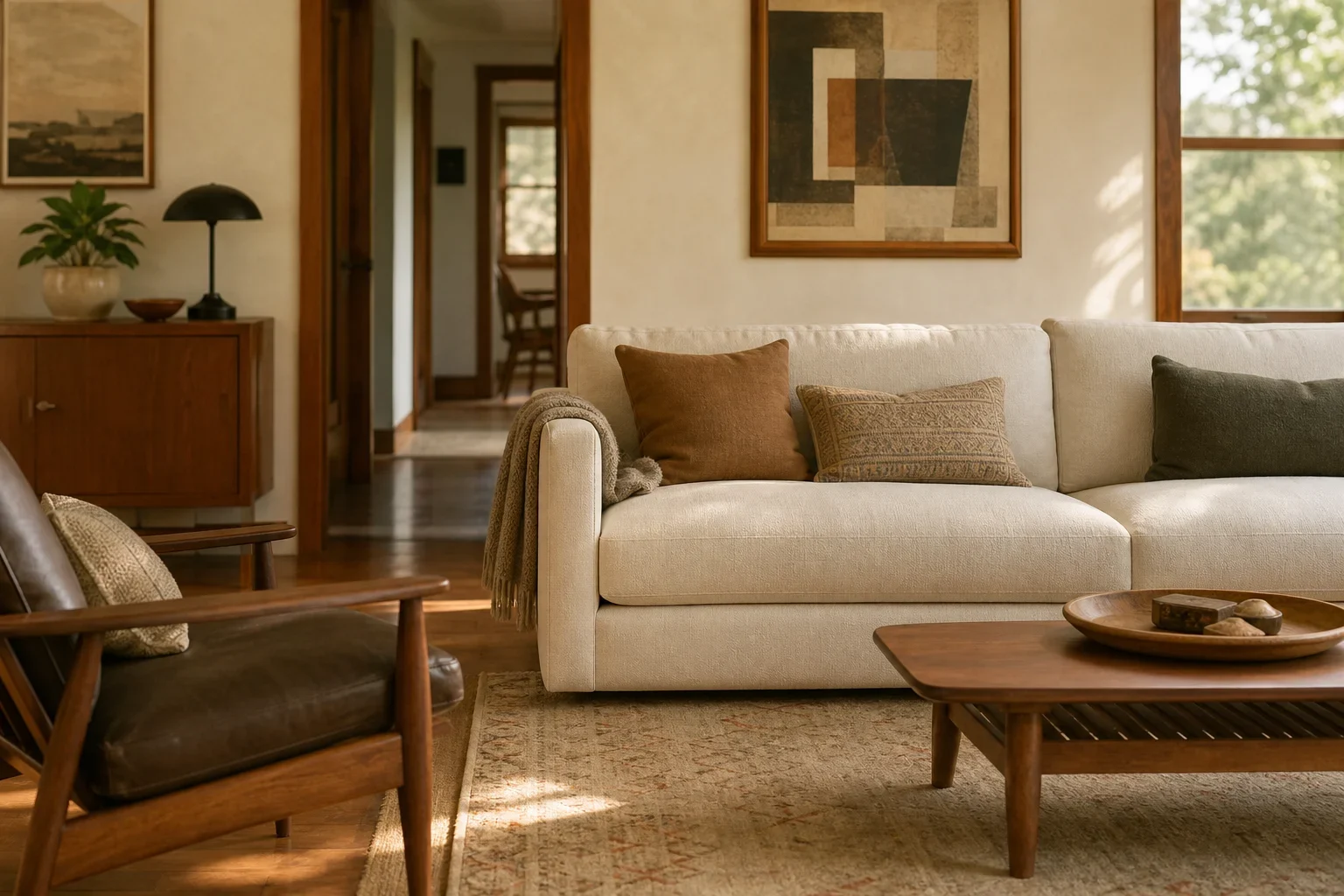
- Coffee tables: Favor glass, lucite, or open-leg wood designs over solid-sided or boxy bases. A tabletop that lets sightlines pass through adds less visual weight to a small room than an opaque block, even at the same footprint.
- Storage ottomans: These are the easiest piece to get wrong, since many storage ottomans are built with a solid skirted base to hide the lid mechanism. If hidden storage matters more than visible legs for your space, that's a reasonable trade-off — just make the choice on purpose rather than by accident.
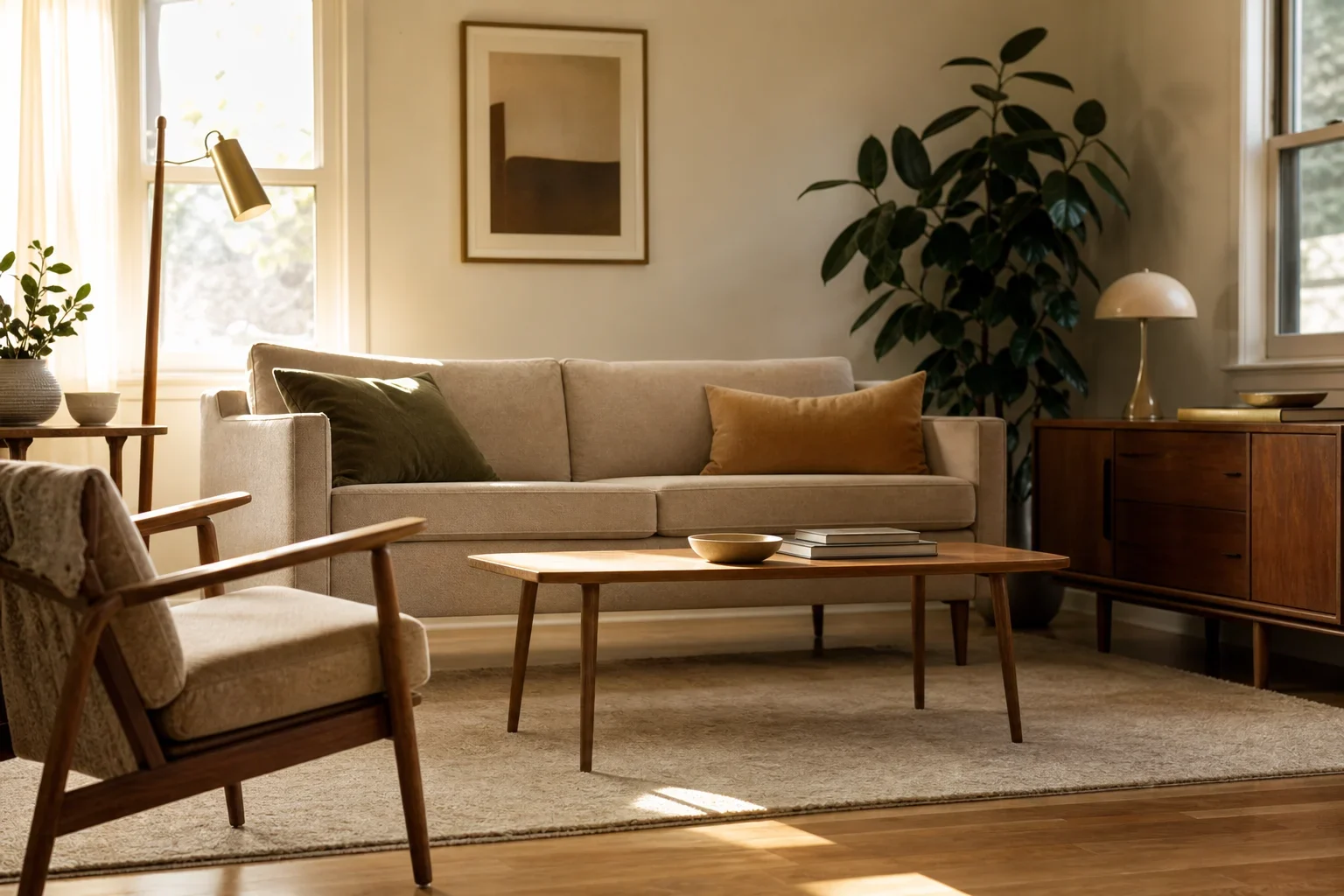
- Side and console tables: These are usually the simplest category for finding open-leg designs, and because they sit near walkways, an open base also avoids adding visual clutter near your main walking path.
- Check the whole room together: One skirted sofa next to three open-leg pieces won't ruin the effect, but a room full of low, skirted furniture will undercut any one visible-leg piece you add. Aim for consistency across your main anchors — sofa, coffee table, and the largest storage piece.
A note on curtains and other floor-level choices
The same logic that applies to furniture legs applies to window treatments: floor-pooling curtains undercut the lightness that visible furniture legs create, because the eye reads a heavy line at the bottom of the window right as it's reading an open line at the bottom of the sofa. If you're furnishing a small apartment from scratch, it's worth applying the same "let the floor show" filter to curtains and rugs, not just seating.
Worked example: the same room, two sofa choices
This is a hypothetical comparison, not a claim about any specific product. Picture an 11×13 ft studio living area with one sofa wall and a single window.
Option A — skirted loveseat: A loveseat with a floor-length fabric skirt sits flush against the wall. No floor is visible beneath it, and a shadow line forms along its base. Visually, the piece reads as a solid block anchoring that side of the room.
Option B — same footprint, 6-inch tapered legs: The identical-size loveseat, but raised on exposed tapered wood legs. Floor is now visible underneath, continuing the sightline from the rug to the wall. Because light reaches under the piece, the shadow band disappears and the loveseat reads lighter even though its actual footprint hasn't changed.
The physical floor space used by each piece is identical — only the visible floor differs. That's the entire principle behind this checklist: you're not necessarily buying a smaller piece, you're buying the version of the same piece that keeps more floor in view.
Mid-century modern product idea: HAIOOU Round Coffee Table for Living Room with Open Storage -Walnut Wood. This round coffee table is a useful stand-in for the article's coffee table checklist item: open, uncluttered bases let sightlines pass through rather than stopping at a solid block, so when comparing it to boxier alternatives, check whether its base and open-storage design keep the floor visible beneath the tabletop rather than enclosing it. Walnut and a round profile also read as consistent with a mid-century look without adding the visual weight a solid-sided table would.
When to skip the visible-leg rule
Visible legs aren't mandatory in every case. If a storage ottoman's hidden-storage capacity matters more to your space than the visual lightness of exposed legs, that's a legitimate trade-off — just make it knowingly rather than by default. Likewise, in a room with low ceilings, very tall legs (8 inches or more) can start to look stilted rather than airy, so match leg height to room proportions rather than maximizing height for its own sake.
Ready to shop? Nido's style quiz narrows your aesthetic in a couple of minutes, and ask Nido or AI picks can surface real, in-stock sofas, coffee tables, and ottomans filtered to your room and budget — useful once you know to ask for open-leg or exposed-base options specifically.
Frequently questions
Frequently asked questions
Does furniture with legs actually make a small apartment look bigger?
The core mechanism is sightlines, not magic: when you can see floor underneath a sofa or table, your eye reads the room as larger because more of the floor surface is visible. One small-room furniture guide ties this to continuous floor visibility and reduced shadow under the furniture, both of which read as more open space, even though the actual square footage hasn't changed.
What leg height works best for a small living room?
Guidance from a furniture-industry source on small-room perception points to roughly 4–8 inches as a workable range, with 6–8 inches often cited as the sweet spot for small rooms specifically — tall enough to show meaningful floor, not so tall that the piece looks perched. In a room with low ceilings, staying toward the lower end of that range tends to look more proportional.
Mid-century modern product idea: Linon Melissa Mid-Century Modern Walnut Console Table. Console tables are flagged in the article as the easiest category to find with an open-leg base, and this walnut mid-century console is a reasonable example to point to when illustrating that point: positioned along a wall or walkway, a console with visible legs avoids adding the clutter a solid-sided piece would create near a main walking path, helping tie the room's smaller anchors to the same visible-leg principle used for the sofa and coffee table.
Should I skip a storage ottoman if it has a skirted base?
Not necessarily — it depends on what you need more. If hidden storage is the main reason you're buying the piece, a skirted base may be worth the trade-off against the visible-leg rule. If the ottoman is mainly serving as a coffee table substitute in an open sightline, an open-leg or glass-top version will keep more floor visible.
Do rugs and curtains matter as much as furniture legs for this effect?
They work alongside the same principle. A rug that extends under a sofa's front legs keeps the floor-to-wall sightline continuous, and floor-pooling curtains undercut the lightness that exposed furniture legs create by adding a heavy line at the bottom of the window. Treating legs, rugs, and curtains as one consistent decision — rather than separate purchases — produces a more noticeable effect than any single piece alone.
Is it worth replacing legs on furniture I already own?
If a sofa or table you own has a removable skirt or swappable legs, raising it can be a low-cost way to test the effect before buying anything new. If the base is fixed or the piece is structurally built for a skirt, it's usually more practical to apply the visible-leg filter to your next purchase instead of retrofitting an existing piece.
Does this rule apply to every piece in the room, or just the sofa?
It applies most visibly to the largest, most central pieces — sofa, coffee table, and any large storage piece — since those are what your eye tracks first when scanning the room. Side tables and consoles are usually easier to find with open-leg designs already, so they're a lower-effort way to build consistency once your main anchor pieces are sorted.
Shop the Mid-century modern look
As an Amazon Associate, Nido earns from qualifying purchases.

Tbfit 77.2" W Linen Sofa Couch, Mid Century Modern Decor Loveseat Couches for Living Room, Button Tufted Upholstered Small Couch for Bedroom, Solid, and Easy to Install Love Seats Furniture, Beige
When shopping for the sofa anchor in the checklist, use this loveseat as a candidate to inspect at the base rather than the fabric: confirm whether the skirt (if any) can be removed or whether the legs sit exposed, since the guide's whole point is that an otherwise similar sofa reads lighter when floor shows underneath it. Its mid-century styling fits the article's broader aesthetic, but treat the actual leg visibility as something to verify on the product listing or in person before counting it as a visible-leg pick.
View on Amazon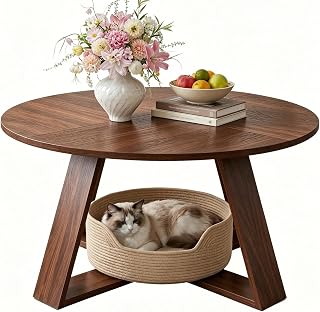
HAIOOU Round Coffee Table for Living Room with Open Storage -Walnut Wood
This round coffee table is a useful stand-in for the article's coffee table checklist item: open, uncluttered bases let sightlines pass through rather than stopping at a solid block, so when comparing it to boxier alternatives, check whether its base and open-storage design keep the floor visible beneath the tabletop rather than enclosing it. Walnut and a round profile also read as consistent with a mid-century look without adding the visual weight a solid-sided table would.
View on Amazon
Linon Melissa Mid-Century Modern Walnut Console Table
Console tables are flagged in the article as the easiest category to find with an open-leg base, and this walnut mid-century console is a reasonable example to point to when illustrating that point: positioned along a wall or walkway, a console with visible legs avoids adding the clutter a solid-sided piece would create near a main walking path, helping tie the room's smaller anchors to the same visible-leg principle used for the sofa and coffee table.
View on Amazon