Tool Storage for a Small Apartment With No Garage: A Checklist
Design theme: Minimalist
No garage, no utility closet, no problem. A practical checklist for storing a small tool kit in a studio or one-bedroom apartment so it stays organized and easy to find.
As an Amazon Associate, Nido earns from qualifying purchases.
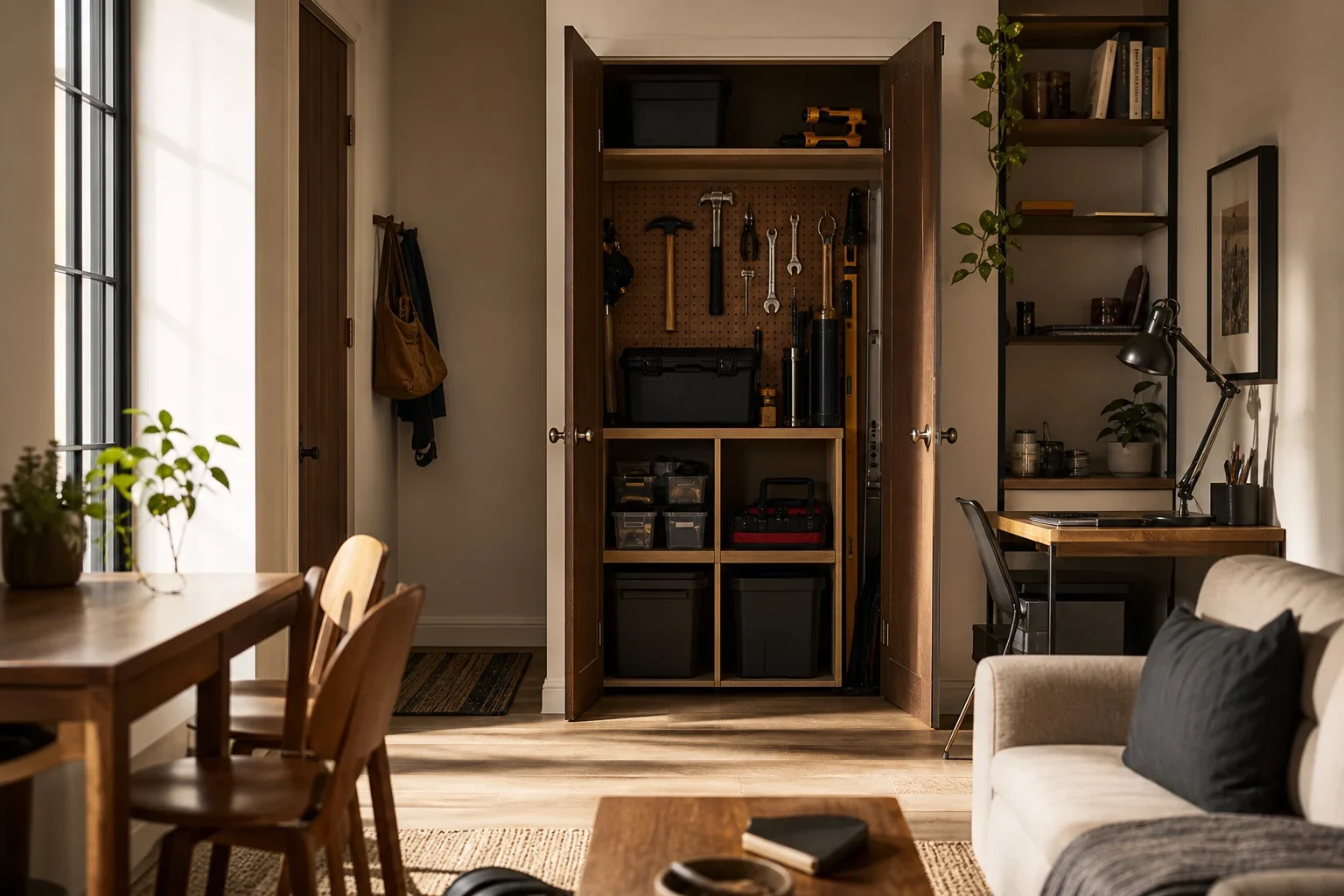
If you're furnishing a small apartment with no garage, no utility closet, and no basement, you still need somewhere to keep the handful of tools that come up constantly — a screwdriver for a wobbly hinge, a hex key for the bookshelf, a tape measure before you buy anything else. The good news is that a first-apartment tool kit is small enough to tuck almost anywhere, as long as you pick a spot on purpose instead of letting tools drift into random drawers. This guide walks through tool storage for a small apartment with no garage, with three realistic setups and a worked example you can adapt to your own floor plan.
If you haven't assembled your kit yet, start with The First Apartment Tool Kit: What to Buy Before You Assemble Anything for what to buy before you worry about where it lives.
Why storage matters as much as the tools themselves
A tool kit you can't find isn't a tool kit — it's just clutter waiting to be rediscovered during your next move. Renters without a garage or basement tend to lose their tools to the backs of closets, random kitchen drawers, or the bottom of a moving box that never got unpacked. One source that covers first-apartment basics suggests tucking a compact kit "on the bottom shelf of a closet or under a sink," using a five-gallon bucket with pocket inserts if a dedicated toolbox doesn't fit your storage{{cite:b963206d-753f-485a-acc4-f237fbd64f9b}}. The principle holds even if you don't have a bucket: pick one home for your tools, make it small enough to fit your space, and keep everything together so you're not hunting for a screwdriver during a 9 p.m. furniture-assembly emergency.
Tool storage for a small apartment with no garage: three realistic setups
Most studios and one-bedrooms have at least one of these three spaces available, even without a garage. Pick the one that matches what you actually have.
1. The under-bed bin
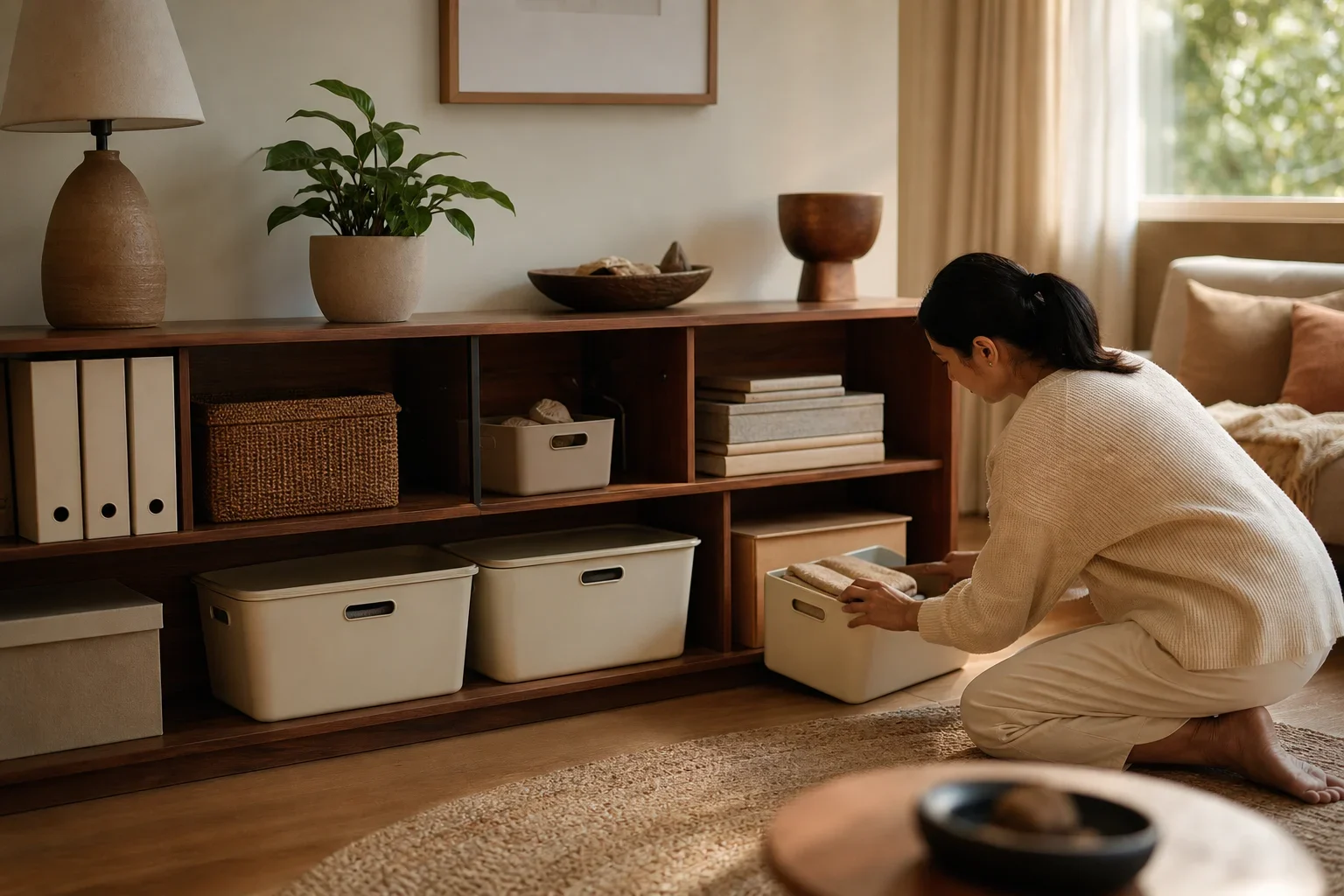
A low, flat storage bin that slides under a bed frame is one of the most space-efficient options in a small apartment, since it uses dead space that's otherwise wasted. It works best for a kit that doesn't need daily access — tools you reach for during move-in week and then occasionally after that. Keep the bin near the foot of the bed (not pushed all the way to the wall) so you're not dragging furniture to get it out.
2. The entryway caddy
If you don't have a coat closet, a small caddy or basket by the front door keeps tools near the spot where packages and flat-pack boxes land. This setup trades a little visibility for convenience — you'll see the caddy every day, which can be a plus if you want tools top-of-mind during an active assembly project, or a minus if you'd rather keep the entryway clear. One guide to renter toolkits for apartment dwellers notes that storage format is a real trade-off: "a hard case offers superior organization and protection, but a soft bag is far more forgiving in tight spaces," so a soft zippered pouch or canvas bin often works better than a rigid toolbox in a snug entryway{{cite:22da4662-e83f-40d2-a74c-616346421096}}.
Minimalist product idea: LANDNEOO 2 Pack Under Bed Storage Containers Bins, Humid-Proof Plastic Underbed Storage Bins, Clothes Storage and Organization Bags, Under the Bed Blanket Storage with Handles for Clothes, Bedroom. A flat, humid-proof bin with handles is a practical match for the under-bed setup described above: slide one beneath the bed frame to hold a soft tool pouch out of sight, then pull it out by the handles whenever a repair comes up. Since it's sold as a two-pack, one bin can hold tools while the other stays free for off-season clothing, which suits a minimalist approach to dividing under-bed space without adding visible clutter to the room.
3. The grab-and-go pouch
A small zippered pouch or soft bag that holds just the essentials — screwdriver, hex keys, tape measure, a few anchors — can live on a closet shelf, in a kitchen cabinet, or even in a drawer, since it takes up barely more room than a lunch bag. This is the setup to pick if your apartment has no single obvious "tool spot" and you'd rather distribute the kit into whatever small gaps exist. One household toolkit checklist describes exactly this idea as a "Go Bucket" kept in a closet with a few essentials that "moves with you from room to room," which is a useful model for a studio where the same bag might travel from the kitchen to the bedroom depending on the job{{cite:29a4fd252c93f5e629630072b76ea2835c49916debea8577ca51eb57b3e65}}.
Worked example: a studio with no closet to spare
Here's a hypothetical walkthrough, not a product recommendation, just to show how the decision plays out in practice.
Situation: A renter named Jordan moves into a 450-square-foot studio with one shallow coat closet already full of outerwear and a vacuum. There's no garage, no basement, and no linen closet.
Step 1 — Inventory the kit. Jordan's tools fit the small, essential list most first-apartment guides recommend: a screwdriver set, a small hammer, a tape measure, a hex key set, pliers, and a utility knife — about seven items total{{cite:161194c01bcd5d6c5aa1a261299344e364b6d4560a301a2d422dadf5be92c255}}.
Step 2 — Rule out the closet. With the coat closet full, Jordan skips the entryway caddy option and looks under the bed instead.
Step 3 — Choose the bin. A flat plastic bin slides under the bed frame with the mattress and bed skirt hiding it completely. Tools go in a soft zip pouch inside the bin so they don't rattle around loose.
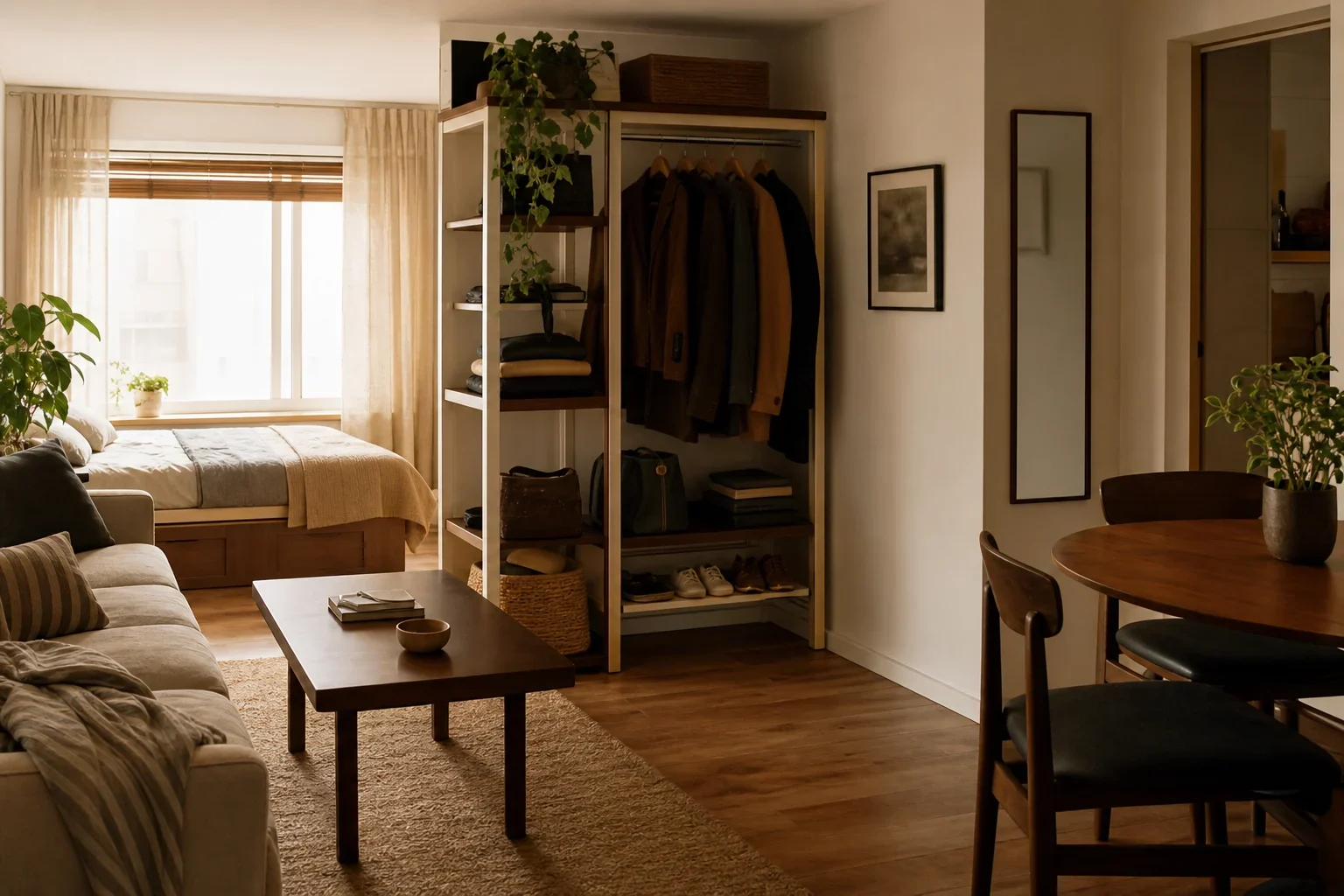
Minimalist product idea: SONGMICS Shoe Rack Bench, 3-Tier Bamboo Entryway Bench, 27.6 Inches Width. For the entryway caddy approach, a slim three-tier bamboo bench gives you a defined, uncluttered landing spot near the door where a small tool pouch or basket can sit on a lower shelf alongside shoes, rather than spreading tools across a counter or floor. Its narrow width is suited to tight entryways, and the bamboo finish keeps the look clean and minimal instead of adding another bulky storage piece to a small apartment.
Step 4 — Set a reminder rule. Jordan commits to returning tools to the bin immediately after each use rather than leaving them on the counter, since a single dedicated spot only works if it's used consistently.
Result: The tools stay out of sight, out of the way of daily life, and findable in under a minute the next time a shelf needs mounting.
A quick decision checklist
- Do you have under-bed clearance? If yes, a flat bin is usually the most space-efficient option.
- Is there any closet space at all, even shared with coats or a vacuum? A small caddy or soft pouch on a shelf works well there.
- No closet and no bed clearance? A grab-and-go pouch in a kitchen cabinet or entryway basket is the fallback.
- Do you reach for tools often (an active assembly week) or rarely (day-to-day small fixes)? Frequent use favors an entryway spot; occasional use favors under-bed storage.
- Will you need to move the kit again soon? A soft bag travels easier than a rigid case when you're also managing moving boxes.
Nido's room-by-room planning tool can help you map out where small essentials like a tool kit fit alongside furniture and storage decisions for each room, so you're not solving the tool-storage question in isolation from everything else you're setting up. And if you're tracking what you've unpacked versus what's still boxed, Nido's moving inventory feature can help you label and find a box of tools quickly during the first chaotic week in a new place.
Frequently asked questions
What's the best way to store tools without a garage or utility closet?
Pick one consistent spot — an under-bed bin, an entryway caddy, or a small grab-and-go pouch — based on what space you actually have free. The specific container matters less than choosing one home and returning tools to it after every use, so you're not searching multiple places the next time something needs fixing.
Should I use a hard case or a soft bag for small-space tool storage?
It depends on your space. A hard case keeps tools more organized and protected, but a soft bag or pouch is more forgiving in tight apartment storage, since it can squeeze into odd-shaped gaps that a rigid case can't{{cite:22da4662-e83f-40d2-a74c-616346421096}}. If you're working with an entryway caddy or a kitchen cabinet, a soft bag is usually the easier fit.
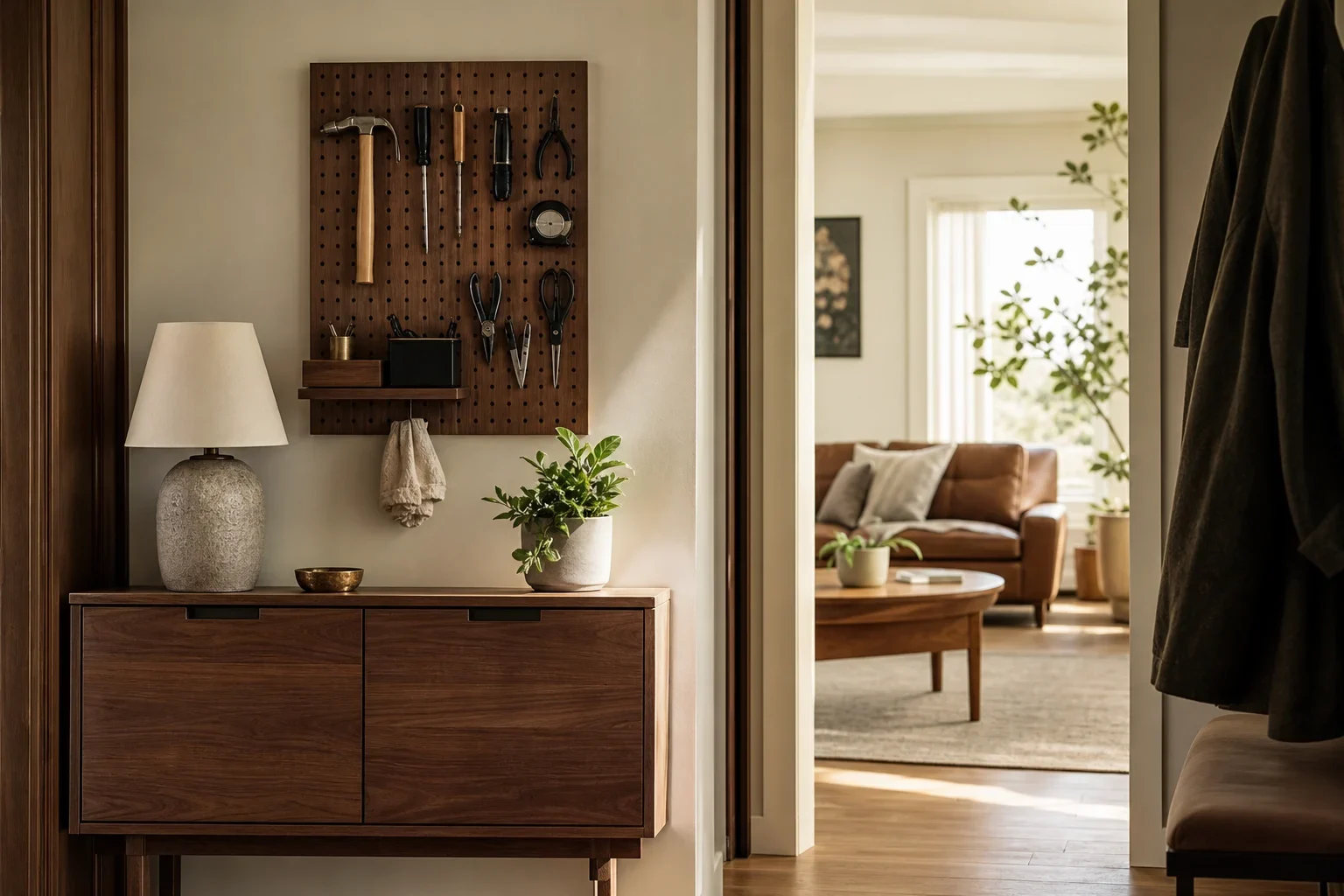
Minimalist product idea: HXOUSE Small Small EDC Pocket Pouch - EDC Organizer Pouch with 4 Pockets for Men, Mini Pocket Tool Pouch for Knife/Flashlight/Tactical Pen - Men's Mini Tool Pouch for Daily Carry. This compact four-pocket pouch fits the grab-and-go setup well: it's sized to hold just the essentials, like a screwdriver, hex key, or utility knife, and tuck into a kitchen cabinet, closet shelf, or drawer without taking up real storage space. Its slim, minimal profile means it won't compete visually with the rest of a pared-down apartment, and it can travel from room to room as different small fixes come up.
Where should I keep tools if I don't have a coat closet either?
An under-bed bin is often the best fallback when there's no closet space at all, since it uses space that would otherwise sit empty. A flat bin with a soft pouch inside keeps tools contained and out of sight, and it slides out easily when you need something.
How many tools do I actually need to store?
A basic first-apartment kit is intentionally small — generally a screwdriver set, a small hammer, a tape measure, a hex key set, pliers, and a utility knife — which means the storage container itself can be modest too{{cite:161194c01bcd5d6c5aa1a261299344e364b6d4560a301a2d422dadf5be92c255}}. You don't need a full toolbox footprint to cover the repairs and assembly jobs that come up in a typical rental.
Can I store tools in the kitchen if that's my only spare space?
Yes, a kitchen cabinet or a shelf above the pantry can work for a grab-and-go pouch, especially in a studio where kitchen storage is the only extra capacity available. Just keep tools in their own bag or small bin rather than loose, so they don't get mixed in with cookware or mistaken for kitchen items.
What if I share the apartment with a roommate?
Agree on one shared spot for the kit so it isn't duplicated or split across two rooms, and make sure both people know where it lives. If you're also sorting out who buys which tools, Nido's shared moving checklist can help you assign ownership and keep track of shared purchases in one place.
Should tool storage change if I move again soon?
If another move is likely, favor a soft, portable pouch over a bulky bin, since it's easier to toss into a moving box or carry separately. Keeping tools in one flexible container also means you won't have to re-sort them from scratch the next time you unpack in a new apartment.
Shop the Minimalist look
As an Amazon Associate, Nido earns from qualifying purchases.

LANDNEOO 2 Pack Under Bed Storage Containers Bins, Humid-Proof Plastic Underbed Storage Bins, Clothes Storage and Organization Bags, Under the Bed Blanket Storage with Handles for Clothes, Bedroom
A flat, humid-proof bin with handles is a practical match for the under-bed setup described above: slide one beneath the bed frame to hold a soft tool pouch out of sight, then pull it out by the handles whenever a repair comes up. Since it's sold as a two-pack, one bin can hold tools while the other stays free for off-season clothing, which suits a minimalist approach to dividing under-bed space without adding visible clutter to the room.
View on Amazon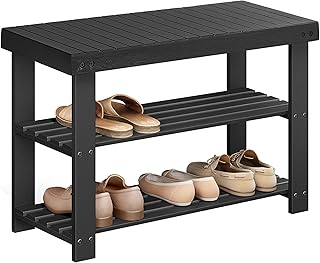
SONGMICS Shoe Rack Bench, 3-Tier Bamboo Entryway Bench, 27.6 Inches Width
For the entryway caddy approach, a slim three-tier bamboo bench gives you a defined, uncluttered landing spot near the door where a small tool pouch or basket can sit on a lower shelf alongside shoes, rather than spreading tools across a counter or floor. Its narrow width is suited to tight entryways, and the bamboo finish keeps the look clean and minimal instead of adding another bulky storage piece to a small apartment.
View on Amazon
HXOUSE Small Small EDC Pocket Pouch - EDC Organizer Pouch with 4 Pockets for Men, Mini Pocket Tool Pouch for Knife/Flashlight/Tactical Pen - Men's Mini Tool Pouch for Daily Carry
This compact four-pocket pouch fits the grab-and-go setup well: it's sized to hold just the essentials, like a screwdriver, hex key, or utility knife, and tuck into a kitchen cabinet, closet shelf, or drawer without taking up real storage space. Its slim, minimal profile means it won't compete visually with the rest of a pared-down apartment, and it can travel from room to room as different small fixes come up.
View on Amazon