What Rooms to Pack First When Moving: A Decision Order From Storage to Kitchen
Design theme: Minimalist
Not sure what rooms to pack first when moving? Use this room-ranking decision filter, with a worked two-bedroom apartment example, to pack in the right order.
As an Amazon Associate, Nido earns from qualifying purchases.
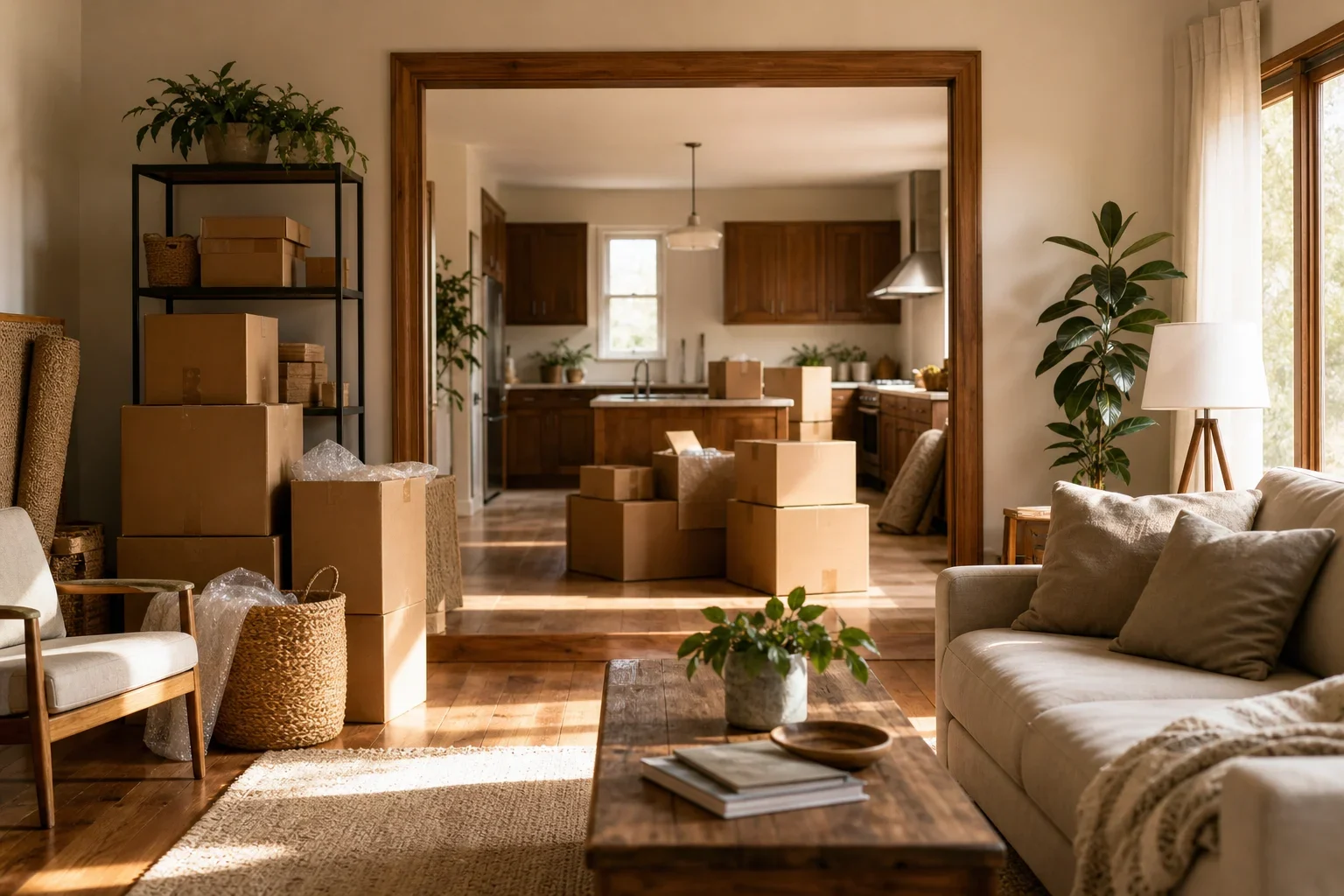
If you're standing in your apartment wondering what rooms to pack first when moving, the answer isn't about which room is biggest or which one has the most stuff. It's about which rooms you can live without the longest. This guide gives you a simple decision filter — ranked from least-lived-in to most-lived-in — and walks through a hypothetical two-bedroom first apartment so you can see the logic applied, not just described.
This is a companion to our week-by-week apartment packing checklist, which lays out a full calendar. Here, instead of asking "what week is it," you're asking "what room am I standing in, and does it need to stay functional today?"
The decision order: what rooms to pack first when moving
Across moving guides, the same logic shows up again and again: start with the spaces you don't use daily, and save the rooms you depend on every single day for last. One widely cited packing guide lays out a room sequence that runs storage areas, then closets and spare rooms, then the kitchen, living room, kids' rooms, bedrooms, and finally the bathroom as the very last room packed, precisely because you need it daily until moving day (MoveAdvisor). For a first apartment, that sequence compresses into five practical stops, because most first apartments don't have an attic, garage, or multiple spare bedrooms to sort through first.
- Storage closets and guest spaces first. Hall closets, under-bed bins, a guest room or home office you rarely sit in. Nothing here affects your ability to cook dinner or sleep tonight.
- Living room decor second. Artwork, books, side tables, and extra decor can come down while you still use the sofa and keep the TV out.
- Bedroom third. Out-of-season clothes, extra linens, and anything in the closet you haven't worn this month. Keep one set of sheets and a week of outfits out.
- Kitchen fourth. This is the hardest room in the apartment to sequence, because it mixes daily-use items with rarely used ones. Pack the duplicate gadgets and good dishes early; leave one pan, one set of plates, and the coffee maker for the final days.
- Bathroom last. You need it every morning until the truck is loaded. Pack only backups and extras until the final 48 hours.
One moving-company guide makes the kitchen's difficulty explicit: it's "the hardest room, every time" because it has the most fragile items and the most daily-use conflict, and recommends packing the rarely used half — china, serving pieces, the gadget drawer — three weeks out, while the everyday half waits for the final two or three days (Gorilla Movers). That's the same logic behind ranking the kitchen fourth here rather than first or last: it has to be split, not packed in one pass.
Minimalist product idea: Small Plastic Storage Bins with Bamboo Lids 5.2qt Stackable Box Basket Pantry Decorative Containers Cute with Labels for Organizing Desktop Closet Office Cream White of 6 packs 10*7.2*4.1". These stackable bins with lids are a natural fit for stop one in the decision order — the storage closets and guest-room overflow you're packing weeks before moving day. Since they're described as stackable and labeled, they suit sorting off-season items, spare office supplies, or guest linens into clear categories early on, so that first pass through rarely used spaces stays organized rather than becoming a pile of loose boxes.
Worked example: a two-bedroom first apartment
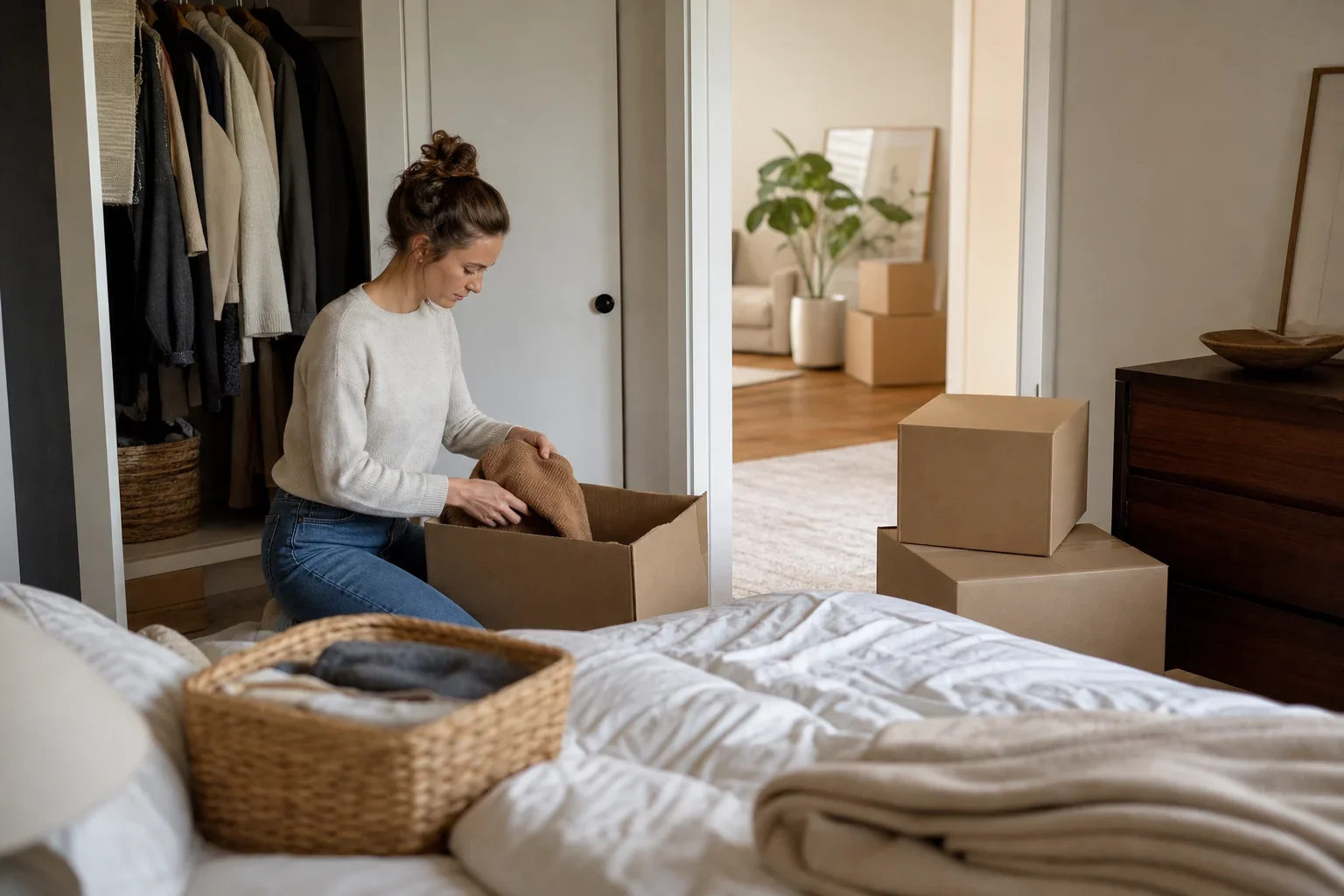
This is a hypothetical walkthrough, not a real household, to show the decision filter in action. Picture a two-bedroom apartment shared by two people: one bedroom is theirs, the second is a guest room that doubles as a home office. They have four weeks before moving day.
| Stop | Rooms/areas | What gets packed | When |
|---|---|---|---|
| 1 | Hall closet, guest room/office | Off-season coats, holiday decor, spare office supplies, guest linens | Weeks 4–3 |
| 2 | Living room | Books, framed art, extra throw pillows, side table, lamps not in nightly use | Weeks 3–2 |
| 3 | Main bedroom | Out-of-season clothes, extra bedding, jewelry (packed for safekeeping, carried separately), closet overflow | Weeks 2–1 |
| 4a | Kitchen — rarely used half | Duplicate gadgets, good dishes, bulk pantry items, serving platters | Week 3 |
| 4b | Kitchen — daily-use half | One pan, a few plates, the coffee maker, everyday utensils | Final 2–3 days |
| 5 | Bathroom | Backup toiletries, extra towels packed early; daily toiletries and one towel set left for the end | Final 1–2 days |
Notice that the guest room goes first precisely because it's not essential for daily life — a reasoning one packing guide states directly when it recommends moving to "spaces like the guest bedroom, home office, and dining room" after storage areas, since they aren't needed day to day (PODS). The same guide saves the kitchen, main bedroom, and living den for last in a full-house timeline; a two-bedroom apartment version just compresses that logic into fewer physical rooms.
How this differs from a week-by-week calendar
A calendar tells you what to do on day 21. This decision filter tells you what to do when you're standing in any given room and can't remember which week it is. If you walk into a room and ask "would I notice if this were gone for a month?" — closets and guest spaces pass that test easily, the kitchen and bathroom fail it until the very end. Use the filter to sense-check your pace against the calendar, not to replace it.
If you're also trying to plan which items in each room matter most, a room-by-room moving checklist can help you see every item for a room priced and organized before you start boxing anything up, so you're packing with a plan rather than guessing room by room.

Minimalist product idea: BOX USA Moving Boxes Holds 65lbs, 18x14x12, Medium 10-Pk for Shipping. A medium box rated to hold weight like this is suited to the heavier middle stops in the sequence — books and decor from the living room, or the rarely used half of the kitchen like good dishes and bulk pantry items. Because the listing specifies a load capacity, it reads as a reasonable match for denser items you're boxing up a few weeks out, rather than the lightweight daily-use essentials you'd leave for the final days.
Frequently asked questions
What rooms to pack first when moving out of a first apartment?
Start with storage closets and any guest room or office space you don't use daily, since nothing there affects your day-to-day routine. From there, move to the living room, then the bedroom, then split the kitchen into rarely used and daily-use halves, and finish with the bathroom, which stays packed last because you need it every morning until moving day.
Why is the kitchen packed fourth instead of last?
The kitchen holds both rarely used items (good dishes, duplicate gadgets, bulk pantry goods) and daily essentials (one pan, your coffee maker, a few plates). Packing the rarely used half around week three and leaving only the daily-use half for the final two or three days is the approach moving guides recommend, since the kitchen mixes fragile items with items you can't live without (Gorilla Movers).
Should the guest room or home office really go before the living room?
Yes, if it's a space you don't sit in daily. The reasoning is straightforward: spaces like a guest bedroom or home office aren't essential to daily life, so they can be boxed up weeks before a living room you still use every evening (PODS).

Minimalist product idea: Avery Multi-Use Labels, 1.5" x 2.75", White, 76 Labels. Blank labels like these support the room-by-room filter directly: as you move through storage, living room, bedroom, and the split kitchen pass, writing the room and contents on each label helps you and movers tell at a glance which boxes are safe to load early and which belong to the daily-use half you're packing last.
What if my apartment doesn't have a guest room?
Then your first stop is simply whatever storage you do have — a hall closet, under-bed bins, a closet shelf of off-season items. The principle is the same: pack what you could go a month without first, regardless of how many separate rooms your apartment actually has.
How does this room order fit with a week-by-week packing calendar?
They're meant to work together. A week-by-week calendar tells you what day to pack on; this room-ranking filter tells you what to prioritize inside any given day, especially when you're behind schedule and need to decide which room to tackle next. If you want the full calendar version, see the week-by-week apartment packing checklist.
What should I pack last in the bathroom?
Keep one towel per person, your daily toiletries, and the shower curtain out until the final day or two. Backup soap, extra towels, and anything you don't use every single day can be boxed earlier, once you've worked through the kitchen's rarely used half.
Shop the Minimalist look
As an Amazon Associate, Nido earns from qualifying purchases.

Small Plastic Storage Bins with Bamboo Lids 5.2qt Stackable Box Basket Pantry Decorative Containers Cute with Labels for Organizing Desktop Closet Office Cream White of 6 packs 10*7.2*4.1"
These stackable bins with lids are a natural fit for stop one in the decision order — the storage closets and guest-room overflow you're packing weeks before moving day. Since they're described as stackable and labeled, they suit sorting off-season items, spare office supplies, or guest linens into clear categories early on, so that first pass through rarely used spaces stays organized rather than becoming a pile of loose boxes.
View on Amazon
BOX USA Moving Boxes Holds 65lbs, 18x14x12, Medium 10-Pk for Shipping
A medium box rated to hold weight like this is suited to the heavier middle stops in the sequence — books and decor from the living room, or the rarely used half of the kitchen like good dishes and bulk pantry items. Because the listing specifies a load capacity, it reads as a reasonable match for denser items you're boxing up a few weeks out, rather than the lightweight daily-use essentials you'd leave for the final days.
View on Amazon
Avery Multi-Use Labels, 1.5" x 2.75", White, 76 Labels
Blank labels like these support the room-by-room filter directly: as you move through storage, living room, bedroom, and the split kitchen pass, writing the room and contents on each label helps you and movers tell at a glance which boxes are safe to load early and which belong to the daily-use half you're packing last.
View on Amazon