What to Pack First for an Apartment Move: A Room-by-Room Checklist
Design theme: Minimalist
A week-by-week, room-by-room checklist for what to pack first in an apartment move — least-used items early, kitchen and bathroom last, plus a first-night box.

As an Amazon Associate, Nido earns from qualifying purchases.
If you've never moved out of an apartment before, the hardest part usually isn't the lifting — it's deciding what to pack first. Pack too much too soon and you're eating cereal off a paper towel for two weeks. Pack too little too late and moving day turns into an all-nighter. This guide walks through what to pack first for an apartment move, checklist by checklist, room by room, so the apartment stays livable right up until the truck pulls away.
What to pack first for an apartment move: the checklist logic
The reasoning underneath every version of this advice — from portable-storage companies to local movers — is the same: pack what you use least first, and save what you touch every day for last. We'll apply that rule specifically to a one- or two-bedroom apartment, where there's no attic or garage to soak up the early boxes.
Packing guides from moving and storage companies converge on one sequencing principle: start with storage areas and items you won't need again until after you've settled into the new place, then work steadily toward the things you touch every day, leaving the kitchen and bathroom for the final stretch.
In a house, that means the attic and garage go first. In an apartment, the equivalent is your closet's top shelf, under-bed storage, out-of-season clothing, and anything you've been meaning to donate. The sequence doesn't change — only the rooms it applies to.
A week-by-week packing order for an apartment move
This is a compressed version of the week-by-week timelines moving companies typically build for full houses, scaled down for a smaller space with fewer rooms and less storage.
| Timeframe | What to pack |
|---|---|
| 4+ weeks out | Closet overflow, seasonal clothing and gear, holiday decor, anything already in storage bins |
| 3 weeks out | Books, artwork, decor, collectibles, rarely used small appliances, fine dishware you don't use weekly |
| 2 weeks out | Extra linens, towels, blankets, rugs you can live without, guest-room or home-office items |
| 1 week out | Most clothing, most kitchenware, non-essential electronics, toys or hobby supplies |
| Final 2–3 days | Daily-use kitchen items, bathroom essentials, the bedding you're currently sleeping on, cleaning supplies |
Adjust the number of weeks to however much runway you actually have before moving day — a monthlong move can compress this into roughly half the time, as long as the order stays the same.
Minimalist product idea: Small Plastic Storage Bins with Bamboo Lids 5.2qt Stackable Box Basket Pantry Decorative Containers Cute with Labels for Organizing Desktop Closet Office Cream White of 6 packs 10*7.2*4.1". These stackable bins fit the 4+ weeks out stage of the checklist, where closet overflow, holiday decor, and rarely used items get boxed first. Clean, uniform bins with labels suit a minimalist approach, since sorting storage-area items into matching containers keeps a small apartment's shelves and closets tidy during the weeks before heavier packing begins.

Which rooms to pack first when moving out of an apartment
Within that calendar, room order follows the same least-used-first logic: storage and closets first, then a guest room or home office if you have one, then living room decor, then the bedroom, then the kitchen, and finally the bathroom — the room you'll use until the hour you leave. A separate, more detailed room-ranking walkthrough is planned for this series if you want a deeper decision filter for a specific apartment layout.
The kitchen and bathroom cutoff
The kitchen is the room every guide singles out as the hardest to pack, because it's full of breakables and also full of things you need for dinner tonight. The practical split: pack the duplicate gadgets, the good dishes, and the bulk pantry items weeks early, and hold back one pot, one set of plates, a few utensils, and the coffee maker until the last couple of days. The bathroom gets the same treatment — pack the extras early, keep one towel, one set of toiletries, and the shower curtain until moving day itself.
Worked example: a one-bedroom apartment, three weeks out
The following is a hypothetical illustration, not a universal rule — use it to see how the sequencing plays out in practice, then adjust the pace to your own timeline.
- Week 1: Pack the hall closet's extra linens, off-season coats, and the box of holiday decorations on the top shelf.
- Week 2: Pack books, framed art, the blender you use twice a year, and the guest set of dishes.
- Week 3 (this week): Pack most clothing into two suitcases' worth minus a few days' outfits, box up the living room decor, and pack non-daily kitchen items.
- Final 3 days: Pack the everyday plates, one pan, bathroom extras, and build the first-night box last.
Build the first-night box last
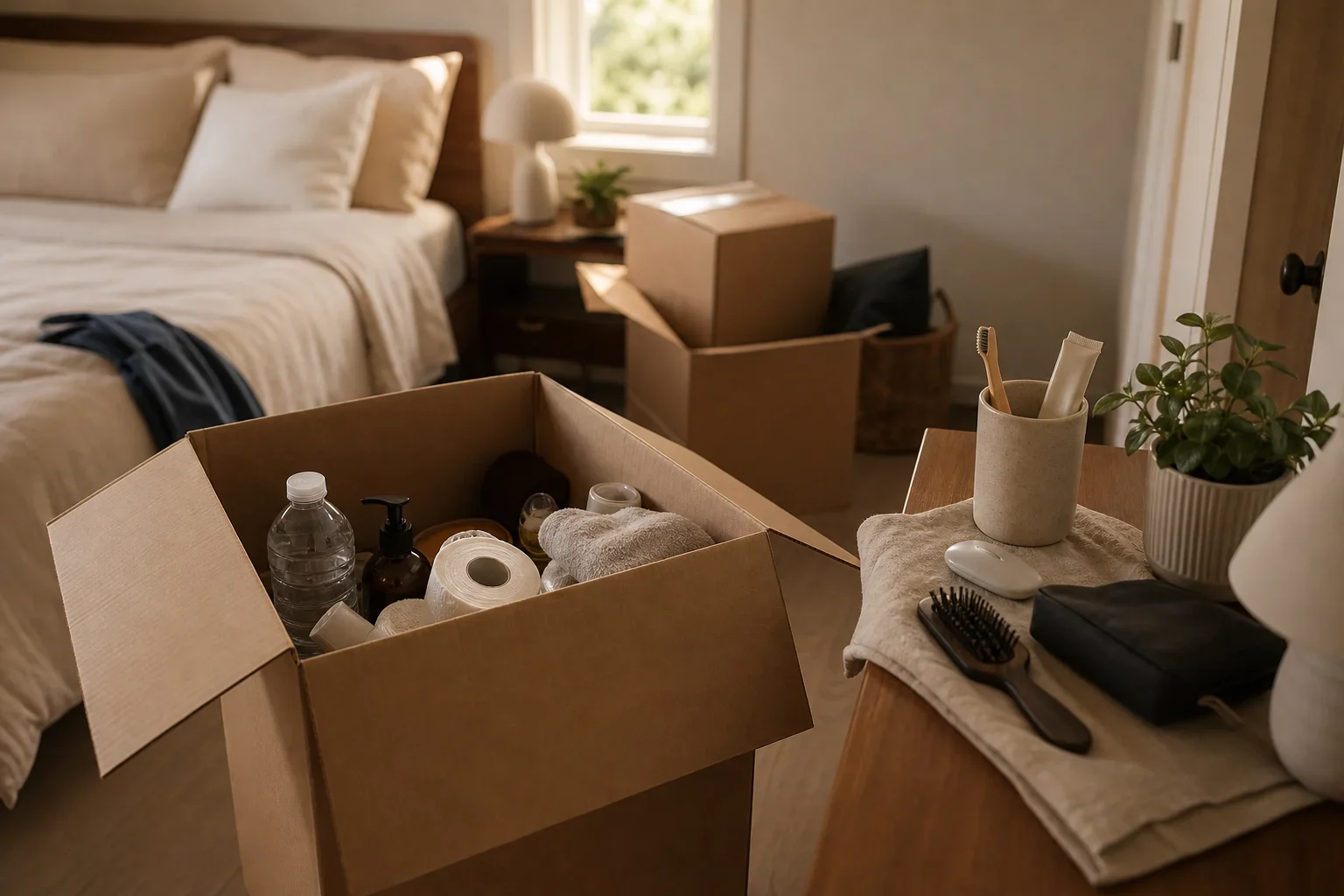
Every moving-industry source on this topic agrees on one more thing: set aside a dedicated box of essentials, pack it last, and keep it out of the truck if at all possible — in your car, or the last thing loaded and first thing unloaded. Here's a distinctive checklist to build it from:
First-night box checklist
- Sheets, a pillow, and a blanket for each bed
- Pajamas and a change of clothes for the next day
- Toiletries: toothbrush, toothpaste, soap, shampoo, toilet paper
- One towel per person and a shower curtain if the new place doesn't have one
- Phone chargers and a power strip
- A box cutter, screwdriver, and any furniture-assembly hardware
- Paper plates, cups, plastic utensils, and a few no-cook snacks
- Medications, glasses, and anything you can't function without for a day
- Pet food, bowls, and a leash if you have a pet
A detailed, category-by-category version of this list — including how to pack and load it so it's genuinely the last box on and the first box off — is planned as a dedicated guide in this series.
What rides with you, not in any box
A smaller, separate list belongs in your bag or car rather than in the first-night box or the truck: IDs, lease or closing documents, keys, jewelry, and anything irreplaceable. These are higher-value, harder-to-replace items than the first-night box's practical essentials, so they get their own container entirely — a distinction a few sources flag but rarely spell out clearly. A dedicated breakdown of this exact split is planned for this series.
Minimalist product idea: Amazon Basics Under Bed Storage Bags for Clothes and Blankets, Foldable Fabric Zipper Container with Clear Window and Reinforced Handles, Space Saving, 18 x 42 x 6 inches, Gray, 2-Pack. Under-bed storage bags map directly onto the guide's point that apartments lack attics or garages, so under-bed space becomes the equivalent storage zone. Using these for out-of-season clothing or extra blankets during the early packing weeks keeps bulky soft goods out of the way without adding visible clutter, which fits a minimalist space that's trying to stay livable while packing is underway.
Label boxes by destination room
Labeling guidance consistently recommends marking boxes with the room they're going to in the new apartment — not the room they came from — plus a brief contents list, written on at least two or three sides so it's visible when boxes are stacked. Some movers add a color per room so helpers can sort by sight instead of reading labels. A fuller walkthrough of setting up that system, plus a way to track what's actually inside each labeled box, is also planned for this series.
Check your pace as you go
Mid-pack, it helps to do a quick gut check: how many boxes are left, divided by how many days remain. If a one-bedroom apartment realistically needs forty to fifty boxes and you have ten days left, that's four to five boxes a day — a pace you can sanity-check against how many you've actually been packing this week. A simple worked calculator for this math is planned as a follow-up in this series.
Where Nido fits into packing week
Packing order is about sequencing boxes; setting up the new place is about sequencing purchases and tasks once you arrive. Nido's new home setup planner turns a short conversation into a room-by-room plan for what to buy and do first, so the unpacking week has the same kind of order the packing weeks did. And its room-by-room checklist breaks furnishing down by room the way this guide breaks packing down by room, which is useful once boxes are unloaded and you're deciding what to set up first. If you're moving in with a roommate or partner, Nido's shared checklist keeps who's-buying-what visible to both of you during the same chaotic week.
For the rooms this checklist treats as lower priority to pack — because they're also lower priority to furnish — see the first apartment bathroom essentials checklist and small apartment storage furniture guide for what to buy once you've unpacked. If you're still deciding what to prioritize buying before move-in at all, the what to buy first for first apartment living guide covers that separately from packing order.
Frequently asked questions
What should I pack first when moving out of an apartment?
Start with whatever you use least: closet overflow, out-of-season clothing, holiday decorations, and anything already sitting in storage bins. These are the easiest decisions to make and the least disruptive to box up weeks before moving day.

Minimalist product idea: SUPVAN E11 Keyboard & Bluetooth Label Maker Machine with 4 Tapes. A label maker supports the guide's labeling-by-destination-room system, letting each box get a clean, consistent tag for its new-apartment room plus a brief contents note instead of handwritten marker labels. Uniform printed labels suit a minimalist aesthetic and make sorting boxes by room faster during the chaotic unload, especially if paired with a color-coded system per room.
What should I pack last in an apartment move?
Daily-use kitchen items (one pan, one set of plates, the coffee maker), bathroom essentials, and the bedding you're currently sleeping on should wait until the final two or three days, along with the first-night box itself, which gets packed dead last.
Do I need a separate first-night box if I'm only moving across town?
Yes — even a short move benefits from one, because the point isn't distance, it's exhaustion. After a full day of loading and unloading, you want sheets, toiletries, and a phone charger findable without opening a dozen identical boxes.
How is the first-night box different from the bag I keep with me?
The first-night box holds practical essentials for the next 24 hours — bedding, toiletries, chargers — and can travel with the move if needed. The separate bag or car load is for higher-value, harder-to-replace items like IDs, keys, documents, and jewelry, which should never go in a box that gets stacked with everything else.
How many boxes should I pack per day before moving?
It depends on your timeline and apartment size, but a rough gut check is total boxes needed divided by days remaining. If that number is climbing faster than you're actually packing, it's a sign to pull a weekend forward rather than compress the final week.
Should I label boxes by the room they came from or the room they're going to?
Label by destination — the room the box is headed to in the new apartment — rather than where it was packed. That one switch is what makes an unload fast instead of a guessing game, especially if you're using a color-coded system per room.
Shop the Minimalist look
As an Amazon Associate, Nido earns from qualifying purchases.

Small Plastic Storage Bins with Bamboo Lids 5.2qt Stackable Box Basket Pantry Decorative Containers Cute with Labels for Organizing Desktop Closet Office Cream White of 6 packs 10*7.2*4.1"
These stackable bins fit the 4+ weeks out stage of the checklist, where closet overflow, holiday decor, and rarely used items get boxed first. Clean, uniform bins with labels suit a minimalist approach, since sorting storage-area items into matching containers keeps a small apartment's shelves and closets tidy during the weeks before heavier packing begins.
View on Amazon
Amazon Basics Under Bed Storage Bags for Clothes and Blankets, Foldable Fabric Zipper Container with Clear Window and Reinforced Handles, Space Saving, 18 x 42 x 6 inches, Gray, 2-Pack
Under-bed storage bags map directly onto the guide's point that apartments lack attics or garages, so under-bed space becomes the equivalent storage zone. Using these for out-of-season clothing or extra blankets during the early packing weeks keeps bulky soft goods out of the way without adding visible clutter, which fits a minimalist space that's trying to stay livable while packing is underway.
View on Amazon
SUPVAN E11 Keyboard & Bluetooth Label Maker Machine with 4 Tapes
A label maker supports the guide's labeling-by-destination-room system, letting each box get a clean, consistent tag for its new-apartment room plus a brief contents note instead of handwritten marker labels. Uniform printed labels suit a minimalist aesthetic and make sorting boxes by room faster during the chaotic unload, especially if paired with a color-coded system per room.
View on Amazon